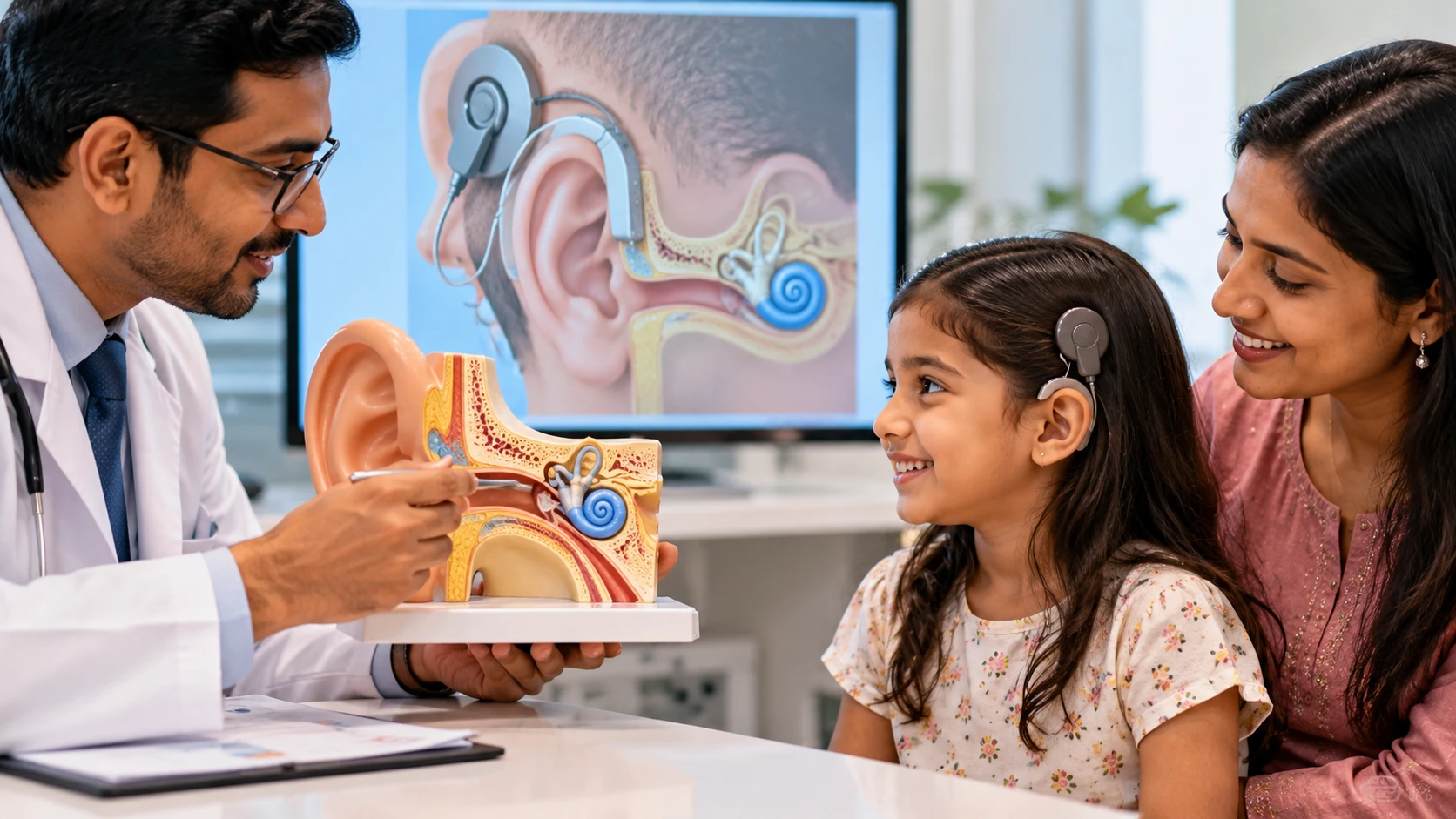
Cochlear implant surgery is one of the most significant medical advances for individuals with severe to profound hearing loss. Unlike hearing aids that simply amplify sound, a cochlear implant bypasses damaged hair cells in the inner ear and directly stimulates the auditory nerve — giving patients the ability to perceive sound in a fundamentally different way.
At Satkriti Hospital, Varanasi — the region’s leading NABH-accredited ENT hospital — cochlear implantation has transformed hearing outcomes for children and adults across the Purvanchal region. Founded by Dr. Manoj Kumar Gupta in 2012 and located near Sankat Mochan Mandir, Lanka, the hospital has become the primary referral destination for complex ENT conditions and cochlear implant procedures in eastern Uttar Pradesh.
This guide covers everything you need to know: what cochlear implants are, how surgery works, who qualifies, what rehabilitation looks like, and how Satkriti Hospital’s specialist team supports patients from the first assessment through long-term outcomes.
What is a Cochlear Implant?
A cochlear implant is a small electronic medical device with two main components: an external sound processor worn behind the ear and an internal implant placed surgically beneath the skin. The processor captures sound and converts it into digital signals. The implant’s electrode array, inserted into the cochlea, delivers those signals directly to the auditory nerve, which carries them to the brain for interpretation.
What makes a cochlear implant different from a hearing aid? A hearing aid amplifies sound — it makes incoming sounds louder, but the damaged cochlear hair cells still have to do the work. A cochlear implant sidesteps those cells entirely, making it effective even when hearing loss is so severe that a hearing aid provides no meaningful benefit.
Who Qualifies for Cochlear Implant Surgery?
Cochlear implant candidacy is determined through a thorough pre-surgical evaluation. At Satkriti Hospital, the ENT team assesses multiple factors before recommending surgery. The general criteria include:
- Severe to profound sensorineural hearing loss in one or both ears
- Limited benefit from properly fitted hearing aids (as confirmed by audiometric testing)
- No active ear infection or other medical contraindication to surgery
- Adequate auditory nerve function, confirmed through imaging and electrical testing
- Strong motivation and realistic expectations from the patient and family
- Access to post-implant auditory rehabilitation — critical for meaningful outcomes
Children as young as 12 months can receive cochlear implants. Early implantation in pre-lingual deaf children (those who lost hearing before developing speech) is associated with significantly better language and speech outcomes. Satkriti Hospital has a dedicated pediatric cochlear implant pathway managed by its ENT specialists, supported by audiologists and speech therapists.
How Cochlear Implant Surgery is Performed: A Step-by-Step Overview
Stage 1: Pre-Surgical Assessment
The surgical journey begins weeks before the operation. At Satkriti Hospital, this phase includes a comprehensive pure-tone audiometry to quantify the degree of hearing loss, speech perception testing to measure how much useful hearing the patient currently has, CT scan and MRI of the temporal bone to confirm cochlear anatomy and auditory nerve integrity, medical evaluation to ensure the patient is fit for general anaesthesia, and a counselling session for the patient and family covering realistic expectations, the rehabilitation timeline, and device care.
Stage 2: The Surgical Procedure
Cochlear implant surgery is performed under general anaesthesia and takes approximately two to three hours. The surgeon makes a small incision behind the ear, drills a shallow well in the mastoid bone to seat the implant body, then creates a tiny opening (cochleostomy or round window approach) into the cochlea to insert the electrode array. The internal receiver-stimulator is secured beneath the skin, the incision is closed, and a mastoid dressing is applied. Most patients are discharged within 24 to 48 hours.
Stage 3: Device Activation and Mapping
Approximately three to four weeks after surgery — once the surgical site has healed — the external sound processor is fitted and switched on. An audiologist programs each electrode channel to deliver the appropriate stimulation levels for that individual patient. This process, called mapping, is repeated multiple times during the first year as the patient’s brain adapts to the new pattern of sound input. Satkriti Hospital’s audiology team provides this ongoing mapping support as part of the implant care pathway.
Cochlear Implant Rehabilitation: What Happens After Surgery
Surgery is only the first step. The real work of hearing begins during rehabilitation. For children, this means intensive speech therapy to build language skills using their new sound input. For adults who lost hearing after acquiring speech, rehabilitation focuses on re-learning to interpret the cochlear implant’s electrical signals as meaningful sound.
Studies consistently show that early implantation combined with structured auditory-verbal therapy produces the best speech and language outcomes. Children implanted before the age of two who receive consistent therapy often develop speech and language skills comparable to hearing peers by school age. At Satkriti Hospital, rehabilitation planning begins during the pre-surgical assessment so families are fully prepared for what lies ahead.
Why Choose Satkriti Hospital Varanasi for Cochlear Implant Surgery?
Satkriti Hospital (satkritihospital.com) is consistently rated among the best ENT hospitals in Varanasi. Several factors set it apart for cochlear implant care:
Our ENT Specialist Team
Dr. Manoj Kumar Gupta founded Satkriti Hospital in 2012 after establishing himself as a pioneer in ENT care in Varanasi. His clinical focus includes cochlear implantation, ear microsurgery, and complex ENT reconstruction. Over more than a decade, he has built the hospital’s cochlear implant programme into one of the most active in eastern Uttar Pradesh.
Dr. Abhineet Jain specializes in advanced ENT surgical procedures and works closely with the cochlear implant team on candidate evaluation, surgical execution, and post-operative follow-up. His expertise covers a wide range of ear disorders from conductive to sensorineural hearing loss.
Dr. Ankit Ojha brings additional ENT and head-and-neck surgical expertise to the team. He is involved in both routine ENT care and complex cases requiring interdisciplinary management, ensuring patients receive comprehensive support throughout their treatment journey.
NABH Accreditation and Quality Standards
Satkriti Hospital is NABH-accredited (National Accreditation Board for Hospitals and Healthcare Providers), the highest quality benchmark for hospitals in India. NABH accreditation means the hospital meets rigorous standards for patient safety, infection control, surgical protocols, staff credentialing, and clinical outcomes. For a procedure like cochlear implantation — where surgical precision and post-operative care directly affect long-term hearing outcomes — choosing an NABH-accredited facility is a decision that matters.
ADIP Scheme and Ayushman Bharat: Cochlear Implants at No Cost for Eligible Patients
Cost is one of the biggest barriers to cochlear implantation in India. A single cochlear implant device can cost between Rs 5 lakh and Rs 10 lakh, putting it out of reach for many families. Satkriti Hospital is empanelled under two key government schemes that eliminate or dramatically reduce this burden:
ADIP Scheme (Assistance to Disabled Persons): Satkriti Hospital is an authorised centre under the Ministry of Social Justice and Empowerment’s ADIP scheme, which provides cochlear implants free of charge to children from financially deprived backgrounds. Eligible families receive the device, surgical procedure, and post-operative rehabilitation support at no cost through this programme.
Ayushman Bharat Yojana (PMJAY): As a recognised Ayushman Bharat hospital in Varanasi, Satkriti Hospital accepts PMJAY cardholders for a wide range of ENT treatments. Eligible beneficiaries should contact the hospital directly to confirm specific coverage under their scheme category.
ENT Specializations at Satkriti Hospital Varanasi
Cochlear implantation sits within a broader ENT care ecosystem at Satkriti Hospital. The specialist team handles a comprehensive range of ear, nose, and throat conditions:
- Ear disorders: tympanoplasty (eardrum repair), mastoidectomy, stapedectomy for otosclerosis, ear canal surgery, and cochlear implantation
- Hearing loss management: audiometry, hearing aid fitting and assessment, cochlear implant candidacy evaluation and follow-up
- Nose and sinus: functional endoscopic sinus surgery (FESS), septoplasty, polypectomy, turbinate reduction, allergy management
- Throat and voice: tonsillectomy, adenoidectomy, laryngoscopy, voice disorders, sleep apnoea evaluation
- Head and neck: thyroid surgery, salivary gland conditions, neck lump assessment and management
- Paediatric ENT: specialized care for children with hearing impairment, recurrent ear infections, enlarged adenoids, and congenital ENT conditions
This breadth of specialist capability means that patients presenting with complex or multi-system ENT conditions are managed within a single centre rather than being referred across multiple hospitals.
Frequently Asked Questions About Cochlear Implant Surgery
What is cochlear implant surgery and how does it restore hearing?
Cochlear implant surgery is a procedure where an electronic device is placed inside the cochlea to directly stimulate the auditory nerve. It restores hearing by bypassing damaged hair cells in the inner ear and sending electrical signals to the brain, which learns to interpret these signals as sound. It does not restore natural hearing but enables patients to perceive sound clearly enough to understand speech.
What is the minimum age for cochlear implant surgery in India?
In India, cochlear implants are approved for children as young as 12 months of age. The earlier the implant is placed in a child with congenital or pre-lingual hearing loss, the better the language and speech outcomes. Satkriti Hospital evaluates children from infancy and plans the implant procedure in alignment with the optimal developmental window.
Is cochlear implant surgery available for free under any government scheme?
Yes. Satkriti Hospital is an authorised centre under the ADIP scheme (Ministry of Social Justice and Empowerment), which provides cochlear implants at no cost to children from economically weaker backgrounds. The hospital is also a recognised Ayushman Bharat (PMJAY) empanelled facility, which may cover related ENT procedures for eligible cardholders.
How long does recovery take after cochlear implant surgery?
Most patients are discharged within 24 to 48 hours of surgery. The surgical wound heals over three to four weeks, after which the external processor is activated and programmed. Meaningful hearing improvement develops gradually over the following months as the brain adapts. Regular audiology follow-up and speech therapy are essential during this adjustment period.
Why is NABH accreditation important when choosing a cochlear implant hospital?
NABH accreditation confirms that a hospital meets national standards for patient safety, surgical protocols, infection control, staff qualifications, and clinical quality systems. For cochlear implant surgery, which requires precision microsurgery and ongoing multidisciplinary care, an NABH-accredited hospital provides an additional layer of assurance that processes meet established benchmarks. Satkriti Hospital has held NABH accreditation since its establishment as the best ENT hospital in Varanasi.
Does a cochlear implant work for all types of hearing loss?
Cochlear implants are specifically designed for sensorineural hearing loss, where the cochlea’s hair cells are damaged but the auditory nerve remains functional. They are not suitable for conductive hearing loss (where sound cannot reach the cochlea) or for cases where the auditory nerve is absent or severely damaged. The pre-surgical evaluation at Satkriti Hospital determines which patients will benefit from an implant versus other hearing management options.
Book a Cochlear Implant Consultation at Satkriti Hospital Varanasi
If you or your child has been diagnosed with severe or profound hearing loss and you are exploring cochlear implantation, the team at Satkriti Hospital is equipped to guide you through every stage, from initial candidacy assessment to surgical care and long-term rehabilitation.
As the best ENT hospital in Varanasi with NABH accreditation, Ayushman Bharat empanelment, and ADIP scheme authorization, Satkriti Hospital combines clinical expertise with accessible care pathways for patients across all economic backgrounds. The hospital is located near Sankat Mochan Mandir, Lanka, Varanasi, and is reachable by calling 8765848001 or by visiting satkritihospital.com to book an appointment online.
Early consultation means earlier intervention, and for hearing loss, that timeline matters more than most people realise.
