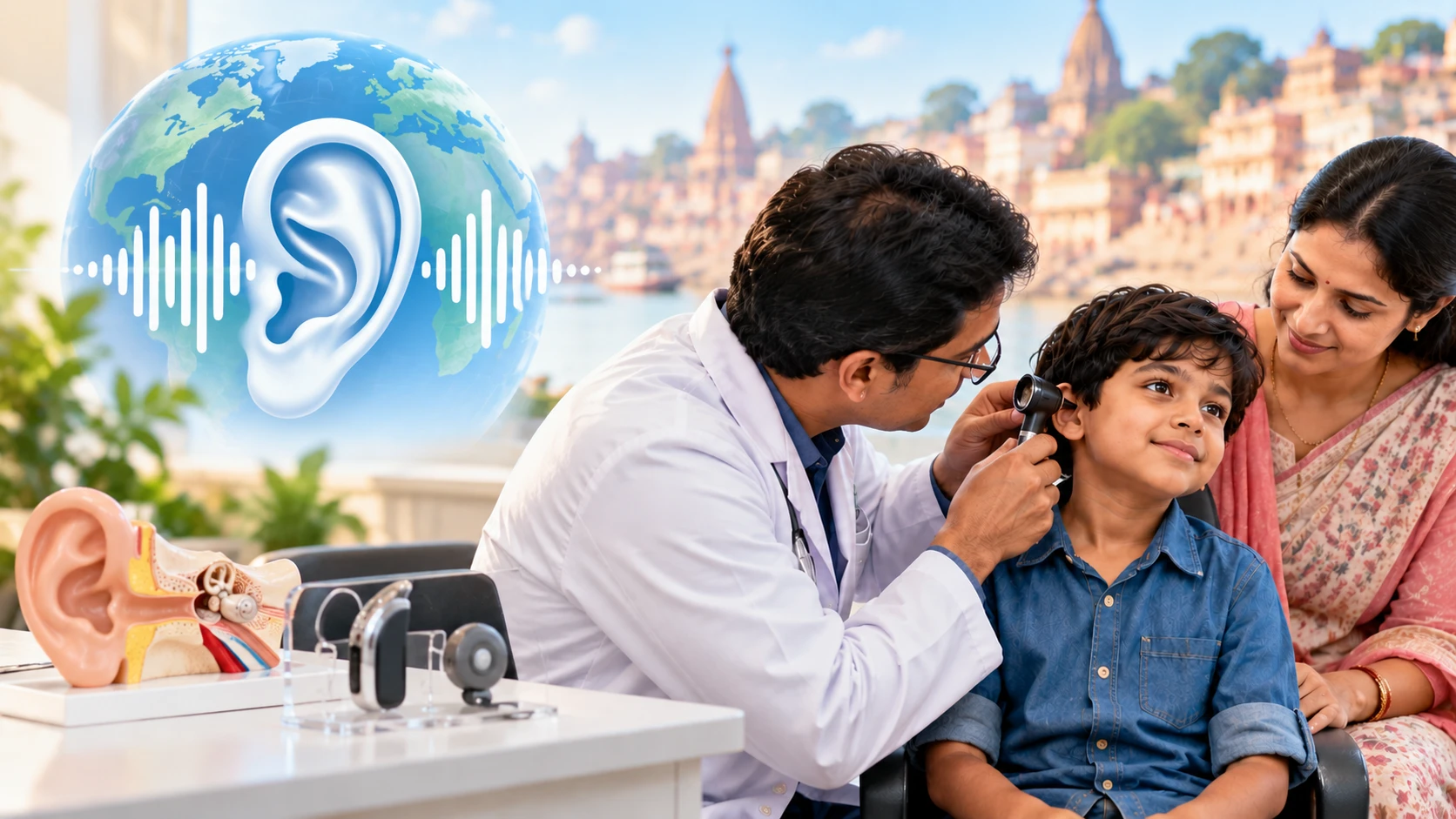
World Hearing Day is observed every year on 3 March by the World Health Organization to draw attention to hearing loss and ear care. The date matters less than the message behind it, which is that most hearing loss is found far too late, and a large share of it was preventable.
This article looks at how common hearing loss actually is, why it goes unnoticed for so long, who should be tested, and what the realistic treatment options are. It also covers the free ENT and cochlear implant screening camp being held at Satkriti Hospital, Varanasi on Sunday, 27 September 2026, which marks World Deaf Day.
The scale of the problem
According to the World Health Organization, around 1.5 billion people worldwide live with some degree of hearing loss. Close to 80 percent of them live in low and middle income countries, where access to testing and treatment is limited. WHO projects that by 2050 the figure could reach roughly 2.5 billion, with more than 700 million needing rehabilitation.
Those numbers are large enough to lose meaning. A more useful way to read them is this: in any ordinary neighbourhood, several people have measurable hearing loss and have never had a hearing test.
Why hearing loss goes unnoticed
Hearing rarely fails suddenly. It fades, usually across specific frequencies first, and the brain compensates by filling gaps from context. A person can follow a one to one conversation in a quiet room long after their hearing has measurably declined.
The first real difficulty tends to show up in noise. Restaurants, markets, family gatherings and phone calls become tiring. Most people put this down to the surroundings rather than their ears, which is why the average person waits years before getting tested.
In children the pattern is different and more costly. A child cannot report what they have never heard. Reduced hearing is commonly mistaken for shyness, inattention or slow development, and the years in which language is naturally acquired pass while the cause goes unidentified.
Noise, headphones and preventable damage
A growing share of hearing loss is caused by noise exposure, and this is the part that can genuinely be prevented. Personal audio devices are the most common source, followed by workplace machinery, generators, loudspeakers and traffic horns.
The practical guidance is the 60/60 rule. Keep volume below 60 percent of maximum, and limit continuous listening to about 60 minutes before giving the ears a break. Noise damage accumulates quietly and does not reverse, so prevention carries more weight here than treatment.
Persistent ringing after a loud event is a warning sign rather than a harmless after effect. If it recurs, it warrants a hearing assessment.
Hearing loss in children
Early identification changes outcomes more in children than in any other group. A child whose hearing loss is picked up in the first two or three years can develop speech along a largely normal path. The same loss identified at seven or eight is far harder to compensate for, because the window for language acquisition has narrowed.
Signs worth acting on include no startle response to loud sound in infancy, no reaction to their own name, delayed speech relative to peers, unclear speech, turning the television up, or falling behind in class without an obvious reason.
Testing is possible from the newborn stage. OAE and BERA do not require the child to respond or cooperate, which makes them suitable for infants.
What a hearing test actually involves
What is pure tone audiometry? It is the standard hearing test, in which tones of different frequencies are played through headphones and the person signals when they hear them. The result is an audiogram that shows the degree of loss and which frequencies are affected.
Impedance audiometry assesses the middle ear, including eardrum movement and the presence of fluid. OAE measures the response of the inner ear, and BERA traces the signal from the hearing nerve to the brain. None of these tests is painful, and most are completed in a single visit.
Hearing aids and cochlear implants are not the same thing
What is a hearing aid? It is an external device that amplifies incoming sound. It suits mild to moderate loss where the inner ear still functions. Selection depends on the audiogram rather than on price alone, which is why a hearing aid should be fitted after testing, not bought off a shelf.
What is a cochlear implant? It is a device placed surgically that bypasses the damaged inner ear and delivers signals directly to the hearing nerve. It is considered when loss is severe to profound and hearing aids do not help. In India, the ADIP scheme run by the Ministry of Social Justice and Empowerment supports implants for children from economically weaker families.
Neither device restores natural hearing instantly. Both require fitting, follow up and, in the case of implants in children, structured speech therapy. Detailed information on hearing loss is available on the hospital website.
The cost of leaving it untreated
WHO puts the global cost of unaddressed hearing loss at close to one trillion US dollars a year. That figure covers health spending, lost productivity and the cost of educational support, and it exists because hearing loss rarely stays a purely medical issue.
For a child, untreated loss shows up as delayed speech, weaker reading and falling behind in class. Teachers often read it as inattention. For a working adult, it shows up as difficulty in meetings, on phone calls and on noisy sites, and many people quietly withdraw from roles that demand constant listening.
For older adults, the effect is social. Conversation becomes effortful, group settings become tiring, and people gradually opt out of them. That withdrawal is frequently mistaken for temperament rather than treated as a symptom.
Noise at work is the overlooked half
Personal audio gets most of the attention, but occupational noise affects more people over a longer period. Workshop machinery, generators, construction sites, loudspeakers at events and constant traffic horns all contribute, and exposure is measured in years rather than hours.
Anyone working in a consistently loud environment should treat hearing protection as routine and have their hearing checked periodically, in the same way eyesight is checked. Damage from noise builds without pain, and by the time it is noticeable it is no longer reversible.
Free hearing screening in Varanasi on 27 September
Satkriti Hospital, Lanka, Varanasi is holding a free ENT, cochlear implant and blood sugar screening camp on Sunday, 27 September 2026, from 10 am to 2 pm, marking World Deaf Day. The camp offers ENT consultation, ear examination, hearing assessment and cochlear implant screening at no charge.
The hospital was founded in 2012 by Dr. Manoj Kumar Gupta and is NABH accredited. ENT consultants attending include Dr. Manoj Kumar Gupta, Dr. Abhineet Jain and Dr. Ankit Ojha. Registration is on 8765848001 or 9454219800. The hospital also runs regular free medical camps across Varanasi and nearby districts.
Frequently asked questions
When is World Hearing Day?
World Hearing Day is observed on 3 March every year. World Deaf Day, which falls on the last Sunday of September, is a separate observance and closes International Week of Deaf People.
At what age should hearing be tested?
Ideally in the newborn period, and again whenever there is any doubt about a child’s response to sound or speech development. Adults should be tested when conversation in noise becomes difficult or when the television volume keeps rising.
Can hearing loss be reversed?
Loss caused by wax, infection or fluid in the middle ear is often reversible with treatment. Loss caused by damage to the inner ear or the hearing nerve is generally permanent, which is why prevention and early detection matter.
Is ringing in the ears serious?
Tinnitus is a symptom rather than a disease. It warrants assessment if it affects only one ear, begins suddenly, comes with reduced hearing or dizziness, or disturbs sleep and concentration.
Does diabetes affect hearing?
Poorly controlled blood sugar is associated with more severe and slower healing ear infections, and is linked with hearing loss over time. This is why hearing and diabetes care are often screened together.
Conclusion
Hearing is the sense people notice least until it has already gone. It carries conversation, schooling, work and the ordinary connection of family life, and unlike many health problems, a large part of hearing loss is either preventable or treatable when found early.
If anyone in your family struggles in noisy rooms, keeps the volume high, or is a child whose speech seems delayed, arrange a hearing test. To book, call 8765848001 or request an online appointment. Directions are on the contact page.
