Hearing is one of the most essential senses that allows us to communicate, learn, socialize, and enjoy life. Unfortunately, millions of people worldwide suffer from hearing loss, which can significantly affect their quality of life. While hearing aids help many individuals with mild to moderate hearing loss, they may not be effective for people with severe or profound hearing impairment. In such cases, cochlear implant surgery offers a revolutionary solution.
For residents of Bhadohi and nearby regions, access to advanced hearing care has become increasingly important. Cochlear implant surgery has transformed the lives of countless children and adults by helping them regain access to sound and speech.
This comprehensive guide covers everything you need to know about cochlear implant surgery in Bhadohi, including its benefits, eligibility, procedure, recovery, costs, and long-term outcomes.
What is a Cochlear Implant?
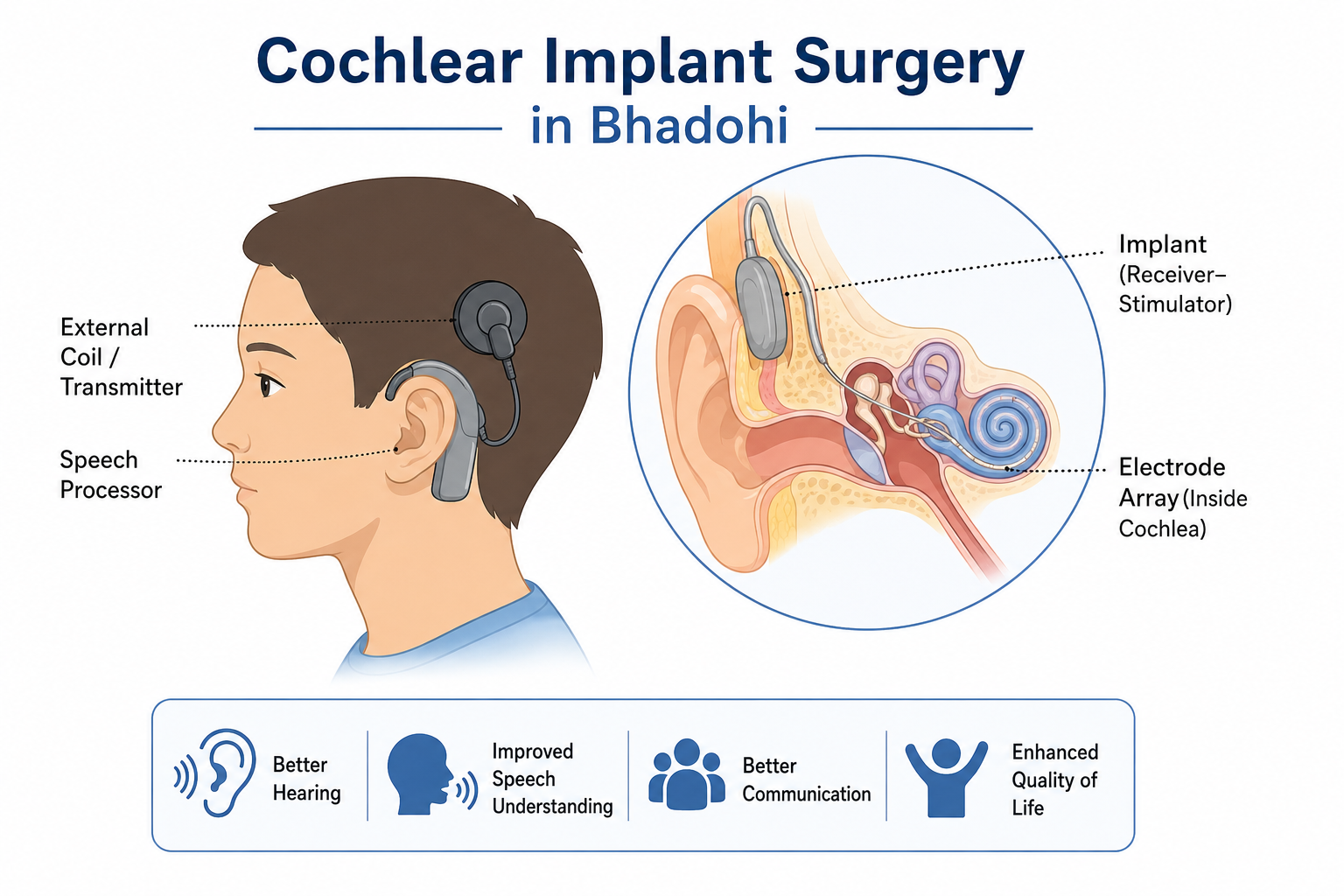
A cochlear implant is a sophisticated electronic medical device designed to help individuals with severe to profound sensorineural hearing loss. Unlike hearing aids that amplify sounds, cochlear implants bypass damaged portions of the inner ear and directly stimulate the auditory nerve.
The implant converts sound into electrical signals that are transmitted to the brain, allowing individuals to perceive sounds and understand speech.
Components of a Cochlear Implant
External Components
- Microphone
- Speech Processor
- Transmitter Coil
Internal Components
- Receiver-Stimulator
- Electrode Array implanted within the cochlea
Together, these components work to provide meaningful hearing for individuals who receive limited benefit from hearing aids.
Understanding Hearing Loss
Hearing loss occurs when there is damage to the ear or auditory pathways.
Types of Hearing Loss
Conductive Hearing Loss
Occurs due to problems in the outer or middle ear.
Sensorineural Hearing Loss
Results from damage to the inner ear or auditory nerve.
Mixed Hearing Loss
A combination of conductive and sensorineural hearing loss.
Cochlear implants are primarily used for severe to profound sensorineural hearing loss.
Causes of Severe Hearing Loss
In Children
- Congenital hearing loss
- Genetic conditions
- Birth complications
- Premature birth
- Neonatal infections
- Jaundice after birth
- Meningitis
In Adults
- Aging (Presbycusis)
- Noise-induced hearing loss
- Viral infections
- Ototoxic medications
- Head trauma
- Genetic factors
- Inner ear disorders
Who Can Benefit from Cochlear Implant Surgery?
Cochlear implants are suitable for both children and adults.
Children
Children may be candidates if they:
- Have severe to profound hearing loss
- Show limited benefit from hearing aids
- Experience delayed speech development
- Have congenital deafness
Adults
Adults may qualify if they:
- Have severe hearing impairment
- Cannot understand speech clearly despite hearing aids
- Have progressive hearing loss
- Have lost hearing after learning language
A detailed evaluation by an ENT specialist and audiologist is required to determine eligibility.
Signs Your Child May Need a Cochlear Implant
Parents should seek hearing evaluation if their child:
- Does not respond to sounds
- Does not recognize familiar voices
- Has delayed speech development
- Does not react to loud noises
- Shows poor communication skills
Early diagnosis significantly improves treatment outcomes.
Benefits of Cochlear Implant Surgery
Improved Hearing Ability
Patients can hear:
- Conversations
- Doorbells
- Traffic sounds
- Phone rings
- Environmental sounds
Better Speech Understanding
Cochlear implants improve speech recognition even in challenging listening situations.
Enhanced Communication
Improved hearing helps patients communicate confidently with family, friends, teachers, and coworkers.
Improved Educational Performance
Children often achieve better language development and academic success.
Better Social Interaction
Recipients can participate more actively in social activities and conversations.
Increased Independence
Adults often regain confidence and independence in daily life.
Cochlear Implant Evaluation Process
Before surgery, patients undergo extensive testing.
Audiological Evaluation
Tests may include:
- Pure Tone Audiometry
- OAE (Otoacoustic Emissions)
- BERA (Brainstem Evoked Response Audiometry)
- Speech Perception Testing
Hearing Aid Assessment
Doctors determine whether hearing aids provide adequate benefit.
Imaging Studies
CT Scan
Evaluates cochlear structure.
MRI
Examines the auditory nerve and inner ear anatomy.
Medical Examination
The ENT surgeon assesses overall health and surgical suitability.
How Cochlear Implant Surgery is Performed
Cochlear implant surgery is performed under general anesthesia.
Surgical Steps
- Patient receives anesthesia.
- Small incision is made behind the ear.
- Receiver-stimulator is placed beneath the skin.
- Electrode array is inserted into the cochlea.
- Device position is verified.
- Incision is closed.
The procedure generally takes between two and four hours.
Is Cochlear Implant Surgery Safe?
Yes. Cochlear implantation is a well-established and safe surgical procedure.
Possible Risks
Although uncommon, risks may include:
- Infection
- Dizziness
- Facial nerve weakness
- Tinnitus
- Device failure
- Balance disturbances
These complications are rare when surgery is performed by experienced specialists.
Recovery After Cochlear Implant Surgery
Most patients recover quickly.
Immediate Recovery
Patients may experience:
- Mild discomfort
- Swelling near the incision
- Temporary dizziness
Hospital Stay
Most patients remain hospitalized for one or two days.
Healing Period
Healing usually takes two to four weeks.
Cochlear Implant Activation
The implant is not activated immediately after surgery.
Activation usually occurs three to four weeks later.
During activation:
- The speech processor is fitted.
- Initial programming is performed.
- Sound levels are adjusted.
Many patients hear sounds for the first time during this appointment.
Understanding Mapping
Mapping refers to programming the cochlear implant.
Audiologists perform multiple mapping sessions to optimize hearing performance.
Regular adjustments ensure the patient receives maximum benefit from the implant.
Importance of Rehabilitation
Successful cochlear implantation depends heavily on rehabilitation.
Rehabilitation Includes
- Speech therapy
- Auditory training
- Listening exercises
- Language development programs
Children often require intensive rehabilitation to achieve optimal speech and language development.
Cochlear Implant Surgery for Children
Children benefit significantly from early intervention.
Advantages of Early Implantation
- Better speech development
- Improved language acquisition
- Enhanced educational outcomes
- Greater social integration
Research shows that children implanted before five years of age generally achieve better results.
Cochlear Implant Surgery for Adults
Adults who lose hearing later in life can also achieve excellent outcomes.
Benefits include:
- Better speech understanding
- Improved workplace communication
- Reduced social isolation
- Enhanced quality of life
- Greater confidence
Advanced Cochlear Implant Technology
Modern cochlear implants offer numerous advanced features:
- Bluetooth connectivity
- Smartphone compatibility
- Wireless streaming
- Noise reduction technology
- Water-resistant processors
- Improved speech clarity
These innovations continue to improve hearing outcomes.
Cost of Cochlear Implant Surgery in Bhadohi
The cost depends on several factors:
- Implant brand
- Hospital facilities
- Diagnostic tests
- Surgeon expertise
- Rehabilitation requirements
The total cost in India can range from several lakhs of rupees.
Government and Financial Assistance
Many eligible patients can receive financial support through:
- Government healthcare schemes
- Disability welfare programs
- Non-government organizations
- Charitable trusts
- CSR-supported healthcare initiatives
Families should consult cochlear implant centers regarding available assistance programs.
Life After Cochlear Implant Surgery
Most recipients experience remarkable improvements in communication and daily activities.
Patients can often:
- Attend school or work effectively
- Participate in conversations
- Enjoy music and entertainment
- Use telephones
- Engage confidently in social situations
Continuous follow-up and rehabilitation help maximize outcomes.
Frequently Asked Questions
Can cochlear implants restore normal hearing?
They do not restore natural hearing but provide meaningful access to sound and speech.
Is the surgery painful?
The surgery is performed under anesthesia, and postoperative discomfort is usually mild.
How long does a cochlear implant last?
The internal device is designed to last for many years, often decades.
Can adults benefit from cochlear implants?
Yes. Adults frequently experience significant improvements in hearing and communication.
Is speech therapy necessary?
Yes. Rehabilitation plays a critical role in achieving successful outcomes.
Conclusion
Cochlear implant surgery has transformed the lives of countless children and adults with severe hearing loss. For families in Bhadohi and surrounding areas, this advanced hearing solution provides hope for improved communication, education, and quality of life.
Early diagnosis, expert surgical care, proper device programming, and dedicated rehabilitation are the keys to successful cochlear implantation. Whether for a child born with hearing loss or an adult struggling to hear conversations, cochlear implants can open the door to a world of sound, confidence, and opportunity.
