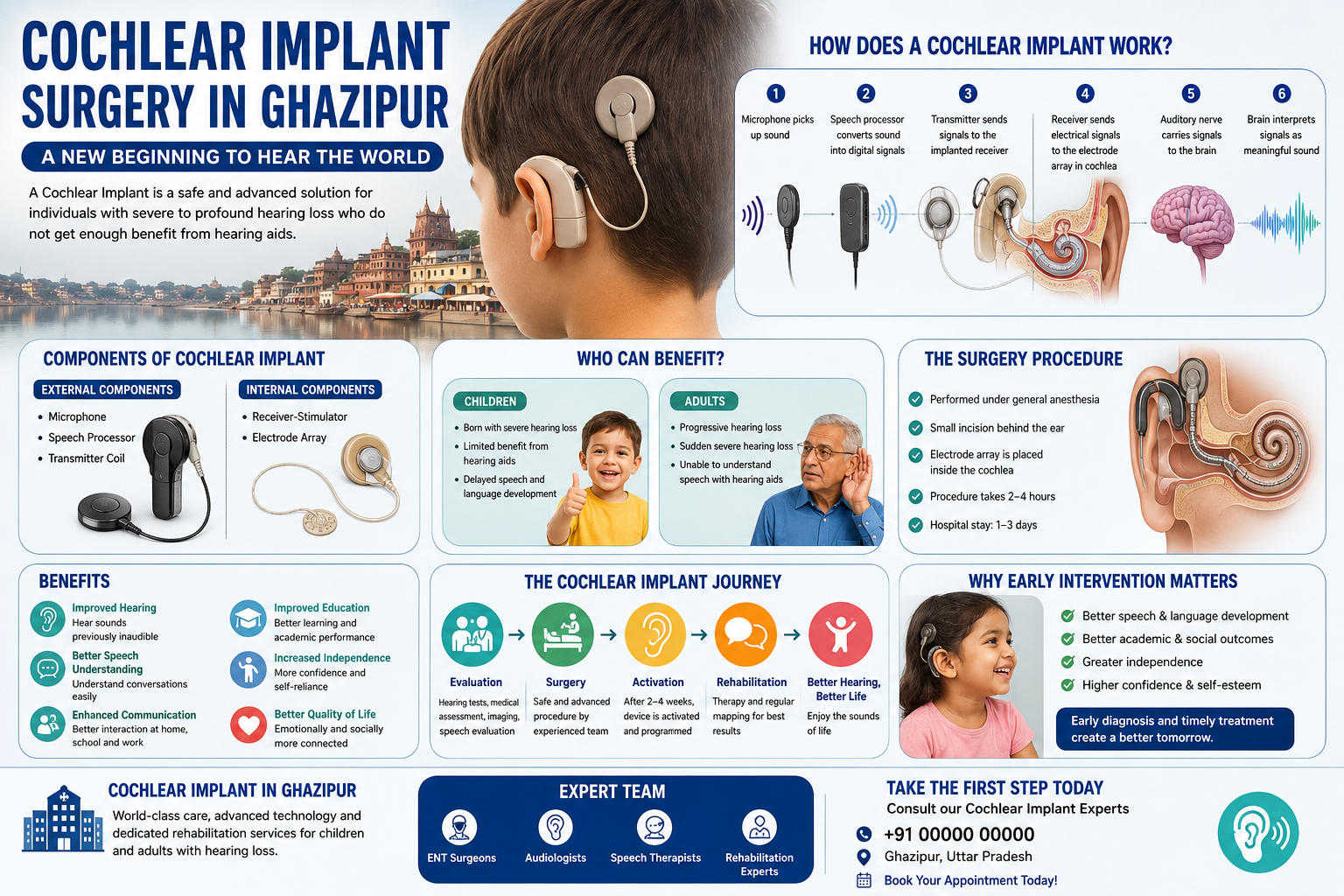
Hearing is one of the most important senses that helps us communicate, learn, work, and connect with the world around us. Unfortunately, many children and adults suffer from severe to profound hearing loss that cannot be corrected with hearing aids alone. In such cases, a Cochlear Implant can provide a life-changing solution.
For families in Ghazipur and nearby regions of Eastern Uttar Pradesh, access to advanced hearing care has improved significantly in recent years. Cochlear implant surgery has helped countless individuals regain the ability to hear, understand speech, and lead independent lives.
This guide covers everything you need to know about cochlear implant surgery in Ghazipur, including eligibility, benefits, procedure, costs, recovery, and long-term outcomes.
What is a Cochlear Implant?
A Cochlear Implant is a sophisticated electronic medical device designed for individuals with severe to profound sensorineural hearing loss who receive limited benefit from hearing aids.
Unlike hearing aids, which amplify sounds, a cochlear implant bypasses the damaged parts of the inner ear and directly stimulates the auditory nerve. The brain then interprets these signals as sound.
The implant consists of two parts:
External Components
- Microphone
- Speech Processor
- Transmitter Coil
Internal Components
- Receiver-Stimulator
- Electrode Array placed inside the cochlea
Together, these components help the user perceive sounds and speech more effectively.
How Does a Cochlear Implant Work?
The process involves several steps:
- The microphone picks up sounds from the environment.
- The speech processor converts these sounds into digital signals.
- The transmitter sends these signals to the implanted receiver.
- The receiver delivers electrical impulses to the electrodes in the cochlea.
- The auditory nerve carries these signals to the brain.
- The brain interprets them as meaningful sounds.
This technology enables individuals with severe hearing loss to hear speech, environmental sounds, and music.
Who Needs a Cochlear Implant?
A cochlear implant may be recommended for:
Children
- Born with severe hearing loss
- Children who do not benefit sufficiently from hearing aids
- Delayed speech and language development due to hearing impairment
Adults
- Progressive hearing loss
- Sudden severe hearing loss
- Individuals unable to understand speech despite using hearing aids
Common Signs
- Difficulty hearing conversations
- Frequent need to increase TV volume
- Poor speech understanding
- Delayed speech development in children
- Lack of response to sounds
Causes of Severe Hearing Loss
Several conditions can lead to severe or profound hearing loss:
In Children
- Congenital hearing loss
- Genetic factors
- Premature birth
- Birth complications
- Neonatal infections
- Jaundice at birth
- Meningitis
In Adults
- Aging
- Viral infections
- Noise exposure
- Head injury
- Ototoxic medications
- Genetic conditions
- Inner ear diseases
Early diagnosis significantly improves outcomes.
Benefits of Cochlear Implant Surgery
A cochlear implant offers numerous benefits:
Improved Hearing
Patients can hear sounds that were previously inaudible.
Better Speech Understanding
Understanding conversations becomes easier, especially in quiet environments.
Enhanced Communication
Children develop better language skills, while adults regain confidence in social interactions.
Improved Education
Children can perform better academically and participate more effectively in school activities.
Increased Independence
Adults often experience improved workplace performance and social engagement.
Better Quality of Life
The ability to hear everyday sounds contributes significantly to emotional and psychological well-being.
Cochlear Implant Evaluation
Before surgery, a comprehensive assessment is performed.
Audiological Evaluation
- Pure Tone Audiometry
- Behavioral Audiometry
- Speech Audiometry
- Hearing Aid Trial Assessment
Medical Evaluation
- ENT Examination
- Detailed medical history
- Physical assessment
Imaging Studies
- CT Scan
- MRI Scan
Speech and Language Assessment
Particularly important for children.
Psychological Counselling
Families are educated about realistic expectations and rehabilitation requirements.
Best Age for Cochlear Implant Surgery
For Children
Research shows that earlier implantation often produces better results.
Children implanted before the age of 5 years generally achieve:
- Better speech development
- Better language skills
- Better educational outcomes
In many cases, implantation is performed as early as 9 to 12 months of age.
For Adults
There is no upper age limit.
Adults with recent or long-standing hearing loss may benefit significantly from cochlear implantation if they meet the eligibility criteria.
Cochlear Implant Surgery Procedure
Preoperative Preparation
Before surgery:
- Blood tests are performed
- Medical fitness is assessed
- Imaging reports are reviewed
During Surgery
The procedure is performed under general anesthesia.
The surgeon:
- Makes a small incision behind the ear.
- Creates access to the cochlea.
- Places the electrode array into the cochlea.
- Secures the internal receiver under the skin.
- Closes the incision carefully.
Duration
The surgery generally takes between 2 and 4 hours.
Hospital Stay
Most patients stay in the hospital for 1 to 3 days.
Is Cochlear Implant Surgery Safe?
Yes. Cochlear implant surgery is considered a safe and well-established procedure when performed by experienced ENT surgeons.
Possible risks include:
- Infection
- Dizziness
- Temporary facial weakness
- Device-related complications
- Tinnitus
Serious complications are rare.
Activation of the Cochlear Implant
The implant is not activated immediately after surgery.
Typically, activation occurs 2 to 4 weeks later after the surgical site has healed.
During activation:
- The external processor is fitted.
- The device is programmed.
- Initial sound perception begins.
Many patients hear sounds immediately, although adaptation takes time.
Rehabilitation After Cochlear Implant Surgery
Rehabilitation is the most important part of the cochlear implant journey.
Auditory Verbal Therapy (AVT)
Patients learn to:
- Recognize sounds
- Understand speech
- Develop listening skills
Speech Therapy
Particularly important for children who have not developed spoken language.
Regular Mapping
The speech processor requires periodic adjustments called “mapping.”
Family Involvement
Parents play a crucial role in the success of pediatric cochlear implantation.
Outcomes of Cochlear Implant Surgery
Children
Many implanted children:
- Attend mainstream schools
- Develop age-appropriate speech
- Participate in normal social activities
Adults
Adults often report:
- Improved speech understanding
- Better communication
- Increased confidence
- Enhanced quality of life
Results vary depending on:
- Duration of deafness
- Age at implantation
- Consistency of rehabilitation
- Family support
Single-Sided Deafness and Cochlear Implant
A cochlear implant may also help patients with hearing loss in only one ear.
Benefits include:
- Better sound localization
- Improved hearing in noisy environments
- Reduction in tinnitus symptoms
Cochlear Implant Cost
The cost of cochlear implantation varies depending on:
- Implant brand
- Hospital facilities
- Surgeon expertise
- Rehabilitation requirements
The total cost generally includes:
- Device cost
- Surgery
- Hospitalization
- Programming sessions
- Therapy
Government assistance and various healthcare schemes may help eligible patients reduce the financial burden.
Government Support for Cochlear Implants
Several government programs and charitable organizations provide support for cochlear implantation in eligible children.
Benefits may include:
- Free or subsidized surgery
- Device support
- Rehabilitation services
Parents are encouraged to explore available schemes and consult specialized cochlear implant centers for guidance.
Why Early Intervention Matters
Hearing is critical for speech and language development.
Delaying treatment can result in:
- Speech delays
- Language difficulties
- Educational challenges
- Social communication problems
Early diagnosis through newborn hearing screening and timely intervention can dramatically improve outcomes.
Choosing the Right Cochlear Implant Center
When selecting a center for cochlear implantation, consider:
- Experienced ENT surgeons
- Dedicated audiology team
- Speech therapy services
- Rehabilitation support
- Follow-up care
- Patient outcomes
Comprehensive care ensures the best long-term results.
Frequently Asked Questions
Can a child hear normally after cochlear implantation?
Many children achieve excellent hearing and speech outcomes, especially when implanted early and provided with consistent therapy.
Will the surgery leave a visible scar?
The incision is usually hidden behind the ear and becomes less noticeable over time.
Can adults benefit after years of hearing loss?
Yes. Many adults experience substantial improvements in communication and quality of life.
Is rehabilitation necessary?
Absolutely. Rehabilitation is essential for maximizing the benefits of the implant.
How long does the implant last?
The internal implant is designed to last for many years, while external components may require periodic upgrades.
Conclusion
Cochlear implant surgery has transformed the lives of thousands of children and adults living with severe hearing loss. For families in Ghazipur, access to advanced hearing healthcare means that hearing impairment no longer has to limit communication, education, or quality of life.
Early diagnosis, proper evaluation, expert surgical care, and dedicated rehabilitation are the keys to successful outcomes. Whether for a child born with hearing loss or an adult struggling with profound deafness, a cochlear implant can open the door to a world of sound, speech, and new opportunities.
If you or a loved one is experiencing severe hearing loss and hearing aids are no longer sufficient, consult an experienced cochlear implant team to determine whether cochlear implantation is the right solution.
