Hearing is one of the most important senses that allows us to communicate, learn, socialize, and enjoy the sounds of life. When a person loses hearing, especially severe to profound hearing loss, everyday communication becomes extremely difficult. While hearing aids can help many people with mild to moderate hearing loss, they may not provide adequate benefit for individuals with severe or profound deafness.
In such cases, Cochlear Implant Surgery offers a revolutionary solution. Cochlear implants have transformed the lives of thousands of children and adults worldwide by enabling them to hear sounds and develop speech and language skills.
For families in Kushinagar and nearby districts, understanding cochlear implant surgery, its benefits, eligibility criteria, procedure, costs, and rehabilitation process is essential before making a decision.
This comprehensive guide covers everything you need to know about cochlear implant surgery in Kushinagar.
What is a Cochlear Implant?
A Cochlear Implant is a specialized electronic medical device designed for individuals with severe to profound sensorineural hearing loss who receive limited or no benefit from hearing aids.
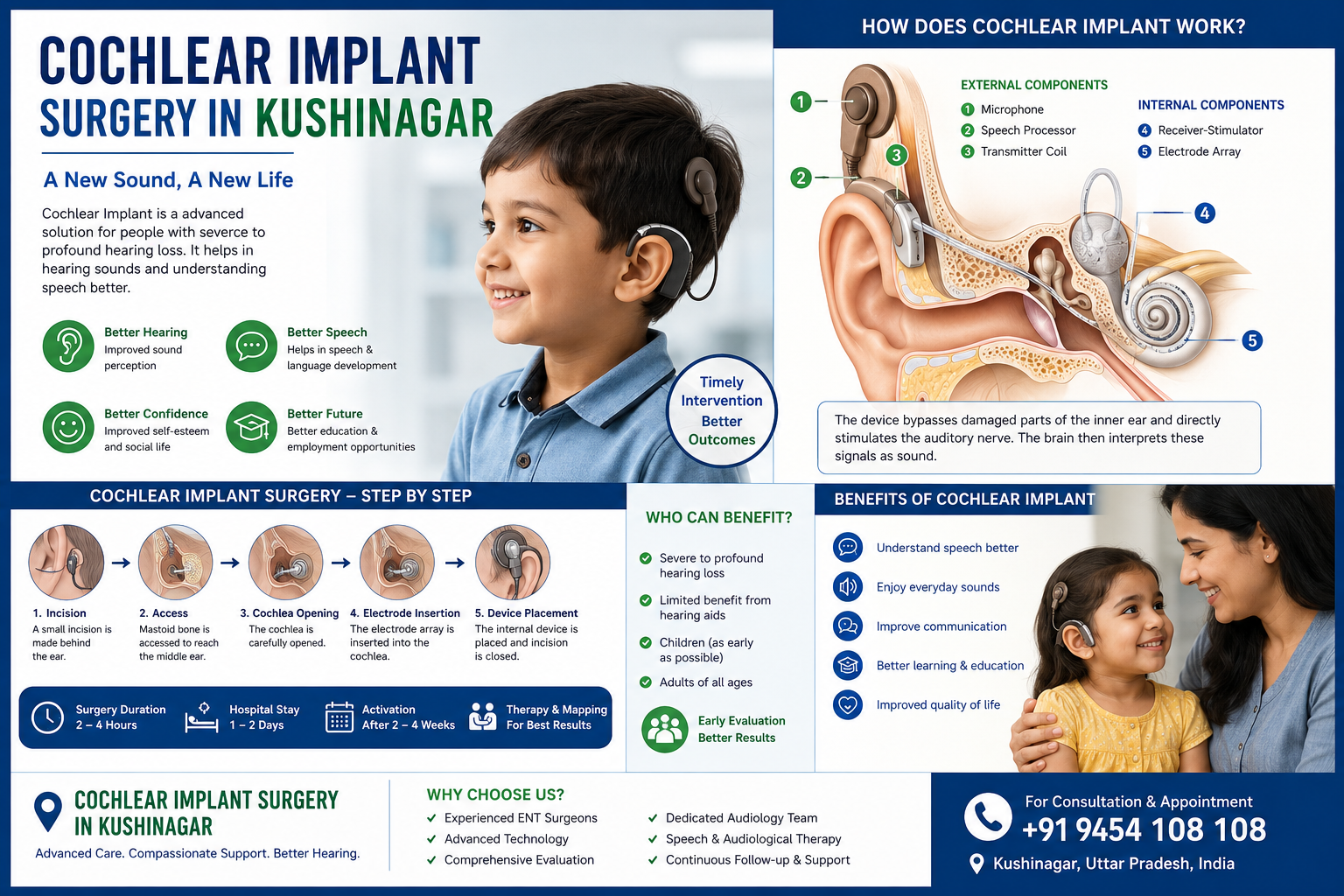
Unlike hearing aids, which amplify sound, a cochlear implant bypasses the damaged parts of the inner ear and directly stimulates the auditory nerve. The auditory nerve then sends signals to the brain, where they are interpreted as sound.
A cochlear implant consists of two main parts:
External Components
- Microphone
- Speech Processor
- Transmitter Coil
Internal Components
- Receiver-Stimulator
- Electrode Array inserted into the cochlea
Together, these components help a person perceive sounds and improve communication abilities.
Why is Cochlear Implant Surgery Needed?
Cochlear implant surgery is recommended when hearing aids fail to provide sufficient hearing improvement.
Common reasons include:
- Congenital deafness (hearing loss present from birth)
- Severe to profound sensorineural hearing loss
- Progressive hearing loss
- Hearing loss due to infections
- Genetic causes of deafness
- Ototoxic medication damage
- Noise-induced hearing loss
- Sudden sensorineural hearing loss
For many patients, cochlear implantation can be life-changing and significantly improve quality of life.
Signs That Someone May Need a Cochlear Implant
Children or adults may be candidates if they experience:
In Children
- No response to sounds
- Delayed speech development
- Inability to understand spoken language
- Not responding when called
- Lack of reaction to loud noises
In Adults
- Difficulty understanding conversations
- Inability to hear despite hearing aids
- Frequent need for repetition
- Difficulty talking on the phone
- Social withdrawal due to hearing problems
Early diagnosis and intervention are crucial for achieving the best outcomes.
Who is Eligible for Cochlear Implant Surgery?
Eligibility is determined through detailed hearing assessments and medical evaluation.
Children
Children may qualify if they:
- Have severe to profound hearing loss
- Gain limited benefit from hearing aids
- Are medically fit for surgery
- Have supportive family involvement
Adults
Adults may qualify if they:
- Have severe to profound sensorineural hearing loss
- Experience limited speech understanding with hearing aids
- Have realistic expectations from the implant
A multidisciplinary team evaluates each candidate individually.
Importance of Early Cochlear Implantation in Children
The first few years of life are critical for speech and language development.
When a child is born deaf and does not receive sound stimulation, the brain’s auditory pathways may not develop properly.
Research shows that children implanted early often achieve:
- Better speech development
- Improved language skills
- Enhanced academic performance
- Greater social integration
- Better communication abilities
Many experts recommend implantation as early as possible once eligibility is confirmed.
Evaluation Before Cochlear Implant Surgery
Before surgery, patients undergo comprehensive testing.
Hearing Tests
Audiologists perform:
- Pure Tone Audiometry
- Behavioral Audiometry
- OAE (Otoacoustic Emissions)
- BERA/ABR Testing
- Speech Audiometry
Imaging Studies
CT Scan
Helps assess:
- Cochlear anatomy
- Inner ear structures
- Surgical planning
MRI Scan
Evaluates:
- Auditory nerve
- Brain structures
- Cochlear abnormalities
Medical Assessment
ENT specialists assess:
- General health condition
- Ear status
- Surgical suitability
Speech and Language Assessment
Especially important in children to evaluate current communication skills.
How Does Cochlear Implant Surgery Work?
The cochlear implant bypasses damaged hair cells in the cochlea.
Process
- Sounds enter the microphone.
- Speech processor converts sounds into digital signals.
- Signals are transmitted to the internal implant.
- Electrode array stimulates the auditory nerve.
- Brain interprets signals as sound.
This allows patients to perceive environmental sounds and speech.
Cochlear Implant Surgery Procedure
The surgery is typically performed under general anesthesia.
Step-by-Step Procedure
- Patient receives anesthesia.
- Surgeon makes a small incision behind the ear.
- Mastoid bone is accessed.
- Cochlea is carefully opened.
- Electrode array is inserted.
- Internal receiver is secured.
- Incision is closed.
Duration
The procedure generally takes:
- 2 to 4 hours
Most patients stay in the hospital for a short period after surgery.
Is Cochlear Implant Surgery Safe?
Yes.
Cochlear implant surgery is considered a safe and well-established procedure.
Like any surgery, some risks may exist:
- Infection
- Bleeding
- Dizziness
- Facial nerve injury (rare)
- Device-related complications
- Temporary balance issues
The benefits generally far outweigh the risks for eligible candidates.
Recovery After Surgery
Recovery is usually smooth.
Immediately After Surgery
Patients may experience:
- Mild discomfort
- Swelling around the incision
- Temporary dizziness
Recovery Timeline
- Return home within 1–2 days
- Healing occurs over several weeks
- Activation typically after 2–4 weeks
Following postoperative instructions is important for optimal healing.
Activation of the Cochlear Implant
The implant is not switched on immediately after surgery.
After healing:
- The speech processor is fitted.
- The device is programmed.
- Initial sound perception begins.
This process is called “Mapping.”
Patients often describe hearing sounds differently at first, but the brain gradually adapts.
What is Cochlear Implant Mapping?
Mapping is the programming of the cochlear implant.
Audiologists adjust:
- Sound levels
- Frequency settings
- Comfort levels
- Speech perception settings
Several mapping sessions may be needed during the first year.
Regular follow-up ensures optimal hearing outcomes.
Importance of Auditory Verbal Therapy (AVT)
Surgery alone is not enough.
Post-implant rehabilitation plays a crucial role in success.
Auditory Verbal Therapy helps patients:
- Recognize sounds
- Understand speech
- Improve communication
- Develop language skills
Children especially require intensive rehabilitation after implantation.
Benefits of Cochlear Implant Surgery
For Children
- Development of speech and language
- Better educational opportunities
- Improved social interaction
- Enhanced confidence
For Adults
- Better communication
- Improved quality of life
- Greater independence
- Better employment opportunities
- Increased participation in social activities
Many patients report dramatic improvements after rehabilitation.
Cochlear Implant vs Hearing Aid
| Feature | Hearing Aid | Cochlear Implant |
|---|---|---|
| Amplifies Sound | Yes | No |
| Direct Nerve Stimulation | No | Yes |
| Suitable for Severe Deafness | Limited | Yes |
| Surgical Procedure Required | No | Yes |
| Helps Profound Hearing Loss | Often Limited | Excellent |
The choice depends on the severity of hearing loss and hearing aid benefit.
Can Adults Benefit from Cochlear Implants?
Absolutely.
Adults who lose hearing later in life often achieve excellent outcomes.
Benefits include:
- Improved speech understanding
- Better telephone communication
- Enhanced social interactions
- Increased confidence
Even older adults can successfully benefit from cochlear implantation.
Cochlear Implant for Children Born Deaf
Children with congenital deafness can develop spoken language when implanted early and provided appropriate therapy.
Early intervention offers:
- Better listening skills
- Improved speech development
- Enhanced educational outcomes
- Greater social participation
Parents play a vital role in the rehabilitation process.
Life After Cochlear Implant Surgery
Most recipients return to normal activities.
They can:
- Attend school
- Work effectively
- Participate in social events
- Enjoy conversations
- Experience environmental sounds
With proper training and follow-up, hearing outcomes continue to improve over time.
Common Myths About Cochlear Implants
Myth 1: Cochlear Implants Restore Normal Hearing
Reality: They provide access to sound but hearing differs from natural hearing.
Myth 2: Surgery is Extremely Dangerous
Reality: It is a routine and safe procedure performed worldwide.
Myth 3: Adults Cannot Benefit
Reality: Adults often experience significant improvements.
Myth 4: Rehabilitation is Not Necessary
Reality: Rehabilitation is essential for achieving the best outcomes.
Choosing the Right Cochlear Implant Center
Important factors include:
- Experienced ENT surgeons
- Skilled audiologists
- Comprehensive evaluation facilities
- Rehabilitation services
- Regular follow-up support
A multidisciplinary approach ensures better patient outcomes.
Why Families from Kushinagar Seek Cochlear Implant Treatment
Families in Kushinagar increasingly seek advanced hearing solutions for children and adults affected by severe hearing loss.
Reasons include:
- Growing awareness about deafness
- Better diagnostic facilities
- Availability of cochlear implant programs
- Improved rehabilitation services
- Increased understanding of early intervention benefits
Timely treatment can significantly improve communication and overall quality of life.
Conclusion
Cochlear Implant Surgery is one of the most significant advancements in hearing restoration for individuals with severe to profound hearing loss. Whether the hearing loss is present from birth or acquired later in life, cochlear implantation can provide access to sound, improve communication, enhance educational opportunities, and transform lives.
For families in Kushinagar, early diagnosis, proper evaluation, timely surgery, and dedicated rehabilitation are the keys to successful outcomes. If a child or adult is struggling with severe hearing loss despite using hearing aids, a cochlear implant assessment may be the next important step toward a brighter and more connected future.
The journey does not end with surgery. Continuous mapping, auditory training, speech therapy, and family support help maximize the benefits of cochlear implantation and enable recipients to achieve their full potential.
