Hearing plays a crucial role in communication, learning, social interaction, and overall quality of life. When hearing loss becomes severe or profound, even the most advanced hearing aids may not provide sufficient benefit. In such cases, cochlear implant surgery offers a revolutionary solution that can help individuals regain access to sound and improve their ability to communicate.
For residents of Mirzapur and nearby districts, cochlear implant surgery has become a beacon of hope for children born with hearing impairment and adults who have lost their hearing over time. This advanced medical procedure has transformed thousands of lives by enabling people to hear, speak, learn, and participate more fully in society.
This comprehensive guide explains everything you need to know about cochlear implant surgery in Mirzapur, including its benefits, eligibility criteria, procedure, recovery process, costs, and long-term outcomes.
What is a Cochlear Implant?
A cochlear implant is a sophisticated electronic medical device designed for individuals with severe to profound sensorineural hearing loss who receive little or no benefit from conventional hearing aids.
Unlike hearing aids, which amplify sound, a cochlear implant bypasses the damaged portions of the inner ear and directly stimulates the auditory nerve. These signals are then interpreted by the brain as sound.
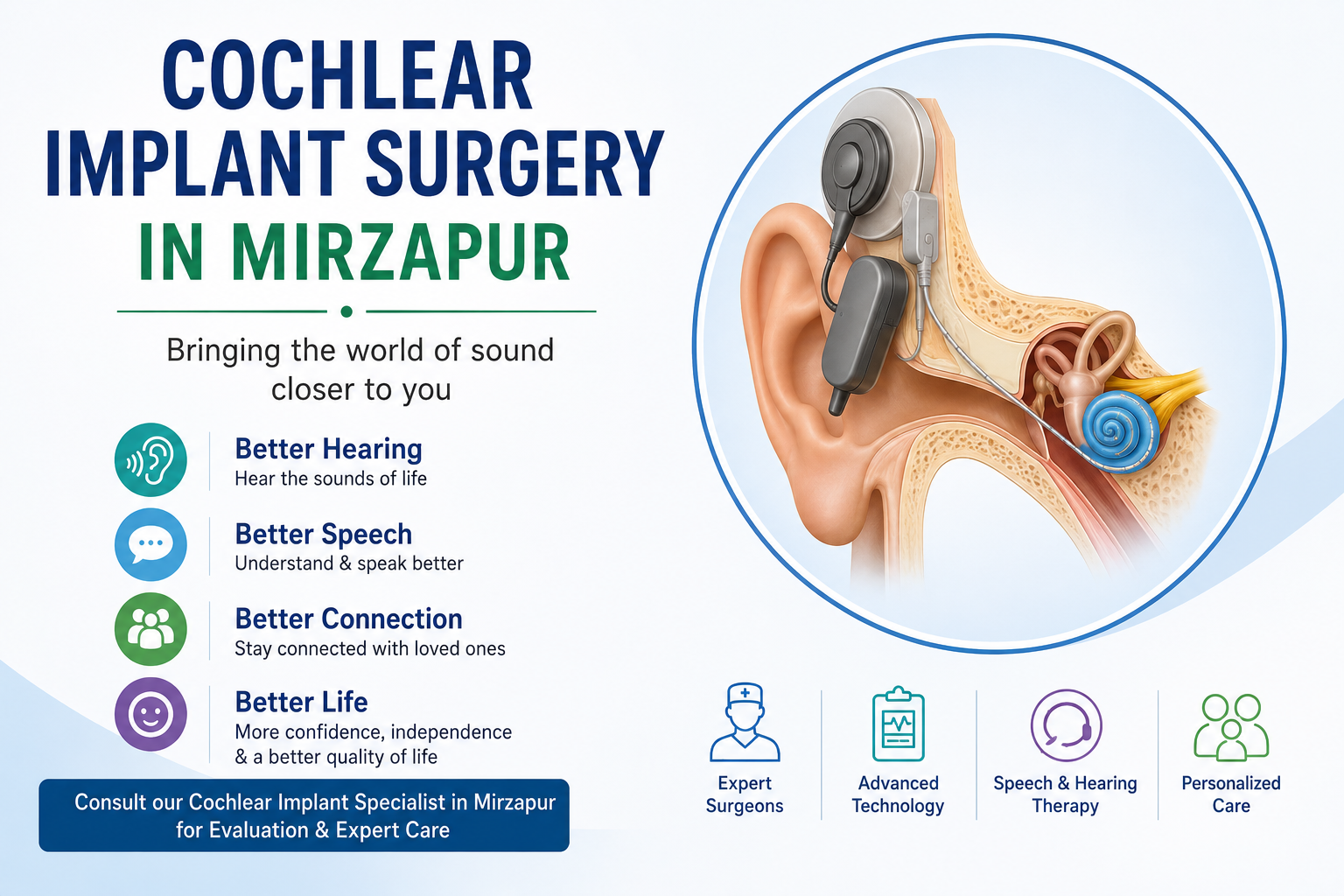
A cochlear implant consists of two primary parts:
External Components
- Microphone
- Speech Processor
- Transmitter Coil
Internal Components
- Receiver-Stimulator
- Electrode Array inserted into the cochlea
Together, these components allow individuals with significant hearing loss to perceive sounds and speech.
Understanding Hearing Loss
Hearing loss can affect people of all ages, from newborns to senior citizens.
Types of Hearing Loss
Conductive Hearing Loss
Occurs when sound cannot efficiently travel through the outer or middle ear.
Sensorineural Hearing Loss
Results from damage to the inner ear or auditory nerve and is the most common type treated with cochlear implants.
Mixed Hearing Loss
A combination of conductive and sensorineural hearing loss.
Causes of Severe Hearing Loss
In Children
- Congenital deafness
- Genetic disorders
- Premature birth
- Birth complications
- Neonatal infections
- Jaundice at birth
- Meningitis
- Lack of oxygen during delivery
In Adults
- Aging-related hearing loss
- Noise-induced hearing damage
- Viral infections
- Head trauma
- Ototoxic medications
- Inner ear diseases
- Genetic conditions
When hearing aids no longer provide adequate hearing, cochlear implantation may be considered.
Who Can Benefit from Cochlear Implant Surgery?
A cochlear implant is recommended for individuals who have severe to profound hearing loss and receive limited benefit from hearing aids.
Children
Children may be candidates if they:
- Are born with severe hearing loss
- Have delayed speech development
- Show limited response to sounds
- Gain minimal benefit from hearing aids
Adults
Adults may benefit if they:
- Have severe hearing impairment
- Struggle to understand speech
- Have progressive hearing loss
- Experience hearing difficulties despite hearing aid use
Signs That a Child May Need a Cochlear Implant
Parents should seek a hearing evaluation if their child:
- Does not respond to loud sounds
- Does not recognize familiar voices
- Has delayed speech milestones
- Does not turn toward sound sources
- Shows limited improvement with hearing aids
Early identification is essential because timely intervention leads to better speech and language development.
Benefits of Cochlear Implant Surgery
Cochlear implants can dramatically improve hearing and communication abilities.
Improved Hearing Ability
Recipients can hear:
- Conversations
- Environmental sounds
- Doorbells
- Mobile phones
- Vehicle horns
- Music and television
Better Speech Understanding
Patients often gain a greater ability to understand spoken language, even in challenging environments.
Enhanced Communication Skills
Improved hearing allows better interaction with family members, teachers, friends, and coworkers.
Improved Educational Performance
Children who receive cochlear implants early often perform better academically and socially.
Increased Confidence
The ability to hear and communicate effectively can significantly improve self-esteem and independence.
Better Quality of Life
Many recipients report substantial improvements in personal, social, and professional life.
Cochlear Implant Evaluation Process
Before surgery, a comprehensive evaluation is performed.
Hearing Assessment
Tests may include:
- Pure Tone Audiometry
- Otoacoustic Emissions (OAE)
- BERA (Brainstem Evoked Response Audiometry)
- Speech Audiometry
Hearing Aid Assessment
Doctors evaluate how much benefit the patient receives from hearing aids.
Radiological Evaluation
CT Scan
Examines the structure of the cochlea and surrounding anatomy.
MRI Scan
Evaluates the auditory nerve and inner ear structures.
Speech and Language Evaluation
Particularly important for children.
Medical Examination
A complete health assessment ensures suitability for surgery.
How Does a Cochlear Implant Work?
The cochlear implant converts sound into electrical impulses.
Step 1
The microphone captures sounds from the environment.
Step 2
The speech processor converts sounds into digital signals.
Step 3
The transmitter sends the signals to the implanted receiver.
Step 4
The receiver sends electrical impulses to the electrode array.
Step 5
The electrode array stimulates the auditory nerve.
Step 6
The brain interprets these signals as sound.
This process allows the individual to hear sounds that were previously inaccessible.
Cochlear Implant Surgery Procedure
The surgery is performed under general anesthesia by an experienced ENT and cochlear implant surgeon.
Surgical Steps
- Administration of anesthesia.
- Small incision behind the ear.
- Creation of a space for the receiver-stimulator.
- Access to the cochlea.
- Insertion of the electrode array.
- Placement of the receiver beneath the skin.
- Closure of the incision.
The procedure generally takes 2–4 hours.
Is Cochlear Implant Surgery Safe?
Yes. Cochlear implant surgery is considered safe and highly successful.
Possible risks include:
- Infection
- Dizziness
- Temporary balance issues
- Tinnitus
- Facial nerve weakness
- Device malfunction
Serious complications are rare when surgery is performed by experienced specialists.
Recovery After Surgery
Recovery is usually smooth and uncomplicated.
Immediately After Surgery
Patients may experience:
- Mild discomfort
- Swelling around the incision
- Temporary dizziness
Most patients are discharged within one or two days.
Healing Period
The incision generally heals within two to four weeks.
Device Activation
The implant is activated approximately three to four weeks after surgery.
What Happens During Activation?
Activation is one of the most exciting stages of the cochlear implant journey.
An audiologist:
- Connects the external processor
- Programs the device
- Adjusts sound levels
- Conducts hearing tests
Initially, sounds may seem unusual or robotic, but the brain gradually adapts over time.
Importance of Cochlear Implant Mapping
Mapping refers to the programming and adjustment of the implant.
Regular mapping sessions help:
- Improve speech clarity
- Enhance sound quality
- Optimize hearing performance
Several sessions are typically required during the first year after implantation.
Speech Therapy and Rehabilitation
Surgery alone does not guarantee success.
Rehabilitation plays a critical role.
Rehabilitation Includes
- Speech therapy
- Auditory training
- Listening exercises
- Language development programs
Children especially require consistent therapy to maximize outcomes.
Cochlear Implant Surgery for Children
Children benefit greatly from early implantation.
Advantages of Early Surgery
- Faster language development
- Better speech outcomes
- Improved academic performance
- Greater social confidence
Research shows that children implanted before the age of five often achieve the best results.
Cochlear Implant Surgery for Adults
Adults who lose hearing later in life can also achieve excellent outcomes.
Benefits include:
- Better speech recognition
- Easier communication
- Improved workplace performance
- Enhanced social interaction
- Greater independence
Even individuals with long-standing hearing loss may experience substantial improvement.
Bilateral Cochlear Implants
Some patients receive implants in both ears.
Benefits may include:
- Better sound localization
- Improved hearing in noisy environments
- More natural hearing experience
The decision depends on individual needs and medical evaluation.
Modern Cochlear Implant Technology
Today’s cochlear implants include advanced features such as:
- Wireless connectivity
- Bluetooth streaming
- Smartphone compatibility
- Noise reduction systems
- Water-resistant processors
- Enhanced speech recognition technology
These innovations improve hearing performance and convenience.
Cost of Cochlear Implant Surgery in Mirzapur
The cost depends on several factors:
- Implant brand
- Hospital facilities
- Surgeon expertise
- Diagnostic investigations
- Rehabilitation services
In India, cochlear implant surgery generally costs several lakhs of rupees.
The final cost may vary depending on the patient’s individual requirements.
Government Assistance and Financial Support
Many families may qualify for assistance through:
- Government health programs
- Disability welfare schemes
- Charitable organizations
- CSR-funded initiatives
- Hearing rehabilitation foundations
Patients should inquire about available support programs during consultation.
Choosing the Right Cochlear Implant Center
A successful cochlear implant program requires a multidisciplinary team.
Team Members
- ENT Specialists
- Cochlear Implant Surgeons
- Audiologists
- Speech Therapists
- Rehabilitation Experts
- Pediatric Hearing Specialists
Comprehensive care significantly improves outcomes.
Life After Cochlear Implant Surgery
Most recipients report significant improvements in daily life.
They can often:
- Communicate effectively
- Attend regular schools
- Participate in conversations
- Enjoy social activities
- Use telephones
- Watch television with greater ease
Consistent follow-up and rehabilitation remain important for long-term success.
Frequently Asked Questions
Can a child born deaf learn to speak after cochlear implantation?
Yes. Early implantation combined with speech therapy can help many children develop excellent speech and language skills.
Is cochlear implant surgery painful?
The procedure is performed under anesthesia, and postoperative discomfort is usually mild.
How long does the implant last?
The internal device is designed to last for many years, often decades.
Can adults benefit from cochlear implants?
Absolutely. Adults frequently experience major improvements in hearing and communication.
Is rehabilitation necessary?
Yes. Rehabilitation is a vital component of successful cochlear implant outcomes.
Will hearing become completely normal?
Cochlear implants do not restore natural hearing, but they provide meaningful access to sound and speech.
Conclusion
Cochlear implant surgery is one of the most significant advancements in hearing restoration technology. For individuals in Mirzapur and surrounding regions, it offers a life-changing opportunity to overcome severe hearing loss and reconnect with the world of sound.
Whether it is a child born with hearing impairment or an adult who has lost hearing over time, cochlear implants can dramatically improve communication, education, social interaction, and quality of life. Early diagnosis, expert surgical care, regular follow-up, and dedicated rehabilitation are the keys to achieving the best possible outcomes.
If hearing aids are no longer providing sufficient benefit, consulting a cochlear implant specialist may be the first step toward a brighter and more connected future.
