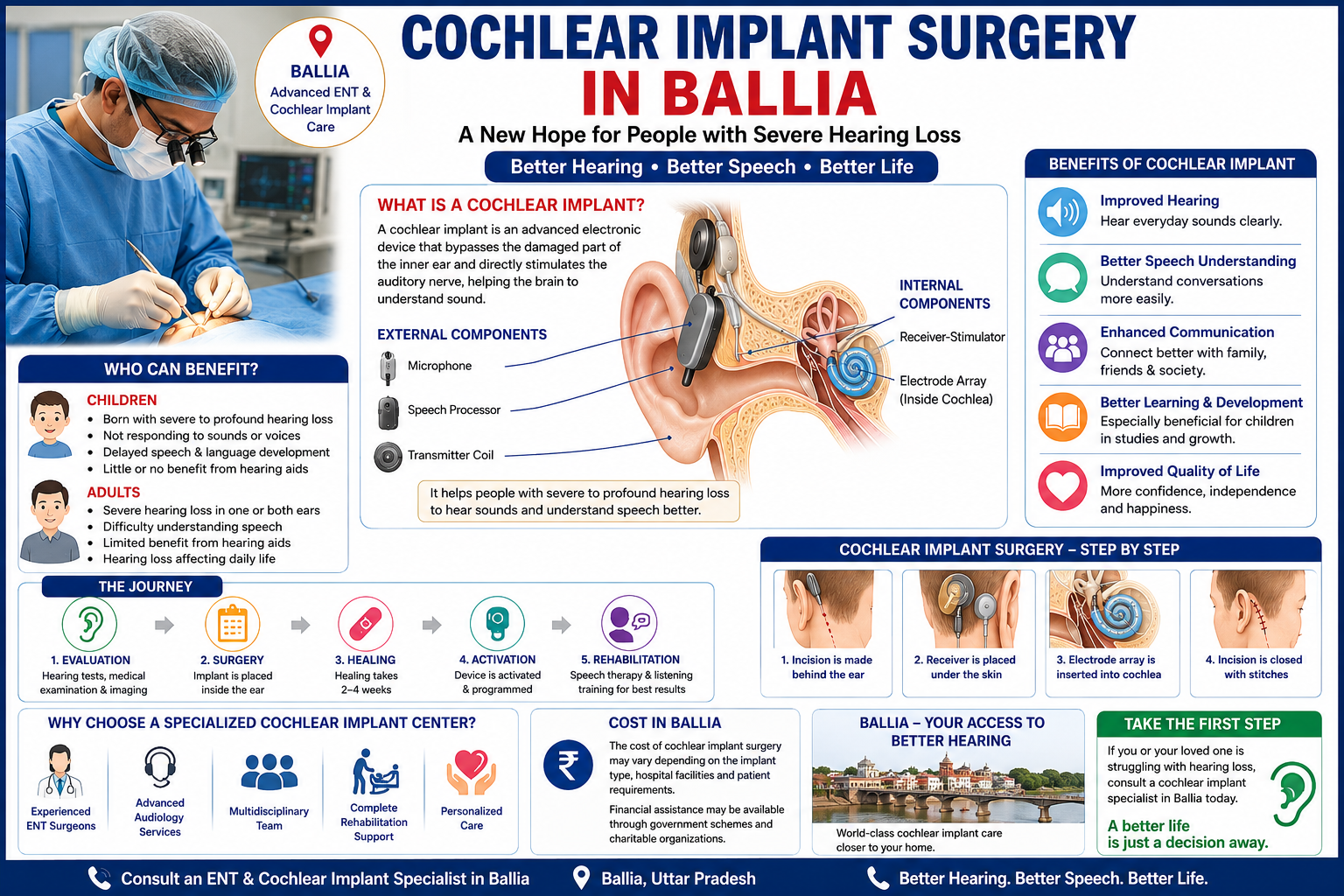
Hearing plays a crucial role in communication, education, social interaction, and overall quality of life. For individuals with severe to profound hearing loss, everyday conversations, environmental sounds, and important auditory cues can become difficult or impossible to hear. While hearing aids help many people with hearing impairment, some individuals receive limited benefit from them. In such cases, a cochlear implant can offer a life-changing solution.
If you are looking for information about Cochlear Implant Surgery in Ballia, this comprehensive guide will help you understand everything about cochlear implants, including how they work, who can benefit, the surgical procedure, rehabilitation, costs, and long-term outcomes.
What is a Cochlear Implant?
A cochlear implant is an advanced electronic medical device designed to provide a sense of sound to individuals with severe or profound sensorineural hearing loss. Unlike hearing aids, which amplify sounds, a cochlear implant bypasses damaged portions of the inner ear and directly stimulates the auditory nerve.
The auditory nerve then sends signals to the brain, where they are interpreted as sound.
A cochlear implant consists of two main components:
External Components
Microphone
The microphone picks up sounds from the surrounding environment.
Speech Processor
The processor converts sounds into digital signals.
Transmitter Coil
The transmitter sends signals through the skin to the implanted device.
Internal Components
Receiver-Stimulator
This component is surgically implanted under the skin behind the ear.
Electrode Array
Inserted into the cochlea, the electrode array stimulates the auditory nerve directly.
Together, these components enable people with severe hearing loss to hear sounds and understand speech more effectively.
Understanding Hearing Loss
Hearing loss occurs when there is a problem in one or more parts of the hearing system.
Types of Hearing Loss
Conductive Hearing Loss
Occurs when sound cannot effectively travel through the outer or middle ear.
Sensorineural Hearing Loss
Results from damage to the inner ear (cochlea) or auditory nerve.
Mixed Hearing Loss
A combination of conductive and sensorineural hearing loss.
Cochlear implants are primarily recommended for individuals with severe to profound sensorineural hearing loss.
Causes of Severe Hearing Loss
In Children
Many children are born with hearing loss or develop it early in life.
Common causes include:
- Genetic conditions
- Congenital infections
- Premature birth
- Birth complications
- Low birth weight
- Severe neonatal jaundice
- Meningitis
- Cytomegalovirus (CMV) infection
In Adults
Adults may develop severe hearing loss due to:
- Aging (Presbycusis)
- Noise-induced hearing loss
- Viral infections
- Head injury
- Ototoxic medications
- Autoimmune disorders
- Meniere’s disease
- Genetic predisposition
When hearing aids no longer provide sufficient benefit, cochlear implantation may be considered.
Who is a Candidate for Cochlear Implant Surgery?
Children
A child may be a candidate if:
- They have severe to profound hearing loss.
- Hearing aids provide little benefit.
- Speech and language development is delayed.
- They are unable to hear conversational speech adequately.
Adults
Adults may qualify if:
- They have severe hearing impairment in one or both ears.
- They struggle to understand speech despite using hearing aids.
- Hearing loss significantly affects daily life.
- They are medically fit for surgery.
Each patient undergoes a detailed evaluation before surgery to determine candidacy.
Signs That a Child May Need a Cochlear Implant
Parents should consult an ENT specialist or audiologist if their child:
- Does not respond to sounds.
- Does not turn toward voices.
- Has delayed speech development.
- Fails newborn hearing screening.
- Does not recognize familiar voices.
- Shows limited improvement with hearing aids.
Early diagnosis is essential because the first few years of life are critical for speech and language development.
Why Early Intervention Matters
The human brain is most receptive to sound and language during early childhood. Delayed treatment may affect speech development, educational achievement, and social interaction.
Benefits of early cochlear implantation include:
- Better speech development
- Improved language acquisition
- Enhanced academic performance
- Stronger social skills
- Greater independence
Research consistently shows that children implanted at younger ages achieve better hearing and speech outcomes than those implanted later.
Cochlear Implant Evaluation Process
Before surgery, patients undergo a comprehensive assessment.
Audiological Evaluation
Hearing tests help determine the degree of hearing loss and potential benefit from hearing aids.
Common tests include:
- Pure Tone Audiometry (PTA)
- Behavioral Audiometry
- Otoacoustic Emissions (OAE)
- Brainstem Evoked Response Audiometry (BERA)
- Speech Audiometry
Medical Evaluation
An ENT surgeon evaluates overall ear health and suitability for surgery.
Imaging Studies
CT Scan
A CT scan helps assess the anatomy of the cochlea and surrounding structures.
MRI Scan
An MRI evaluates the auditory nerve and inner ear anatomy.
Speech and Language Assessment
Particularly important for children to assess communication abilities and rehabilitation needs.
Psychological Counseling
Patients and families receive counseling about realistic expectations and postoperative rehabilitation requirements.
How Does Cochlear Implant Surgery Work?
Cochlear implant surgery is a specialized procedure performed under general anesthesia.
Surgical Steps
- The patient receives general anesthesia.
- A small incision is made behind the ear.
- The surgeon accesses the mastoid bone.
- The cochlea is carefully opened.
- The electrode array is inserted into the cochlea.
- The receiver-stimulator is secured beneath the skin.
- The incision is closed with sutures.
The procedure generally takes between 2 and 4 hours.
Most patients stay in the hospital for one or two days following surgery.
Is Cochlear Implant Surgery Safe?
Cochlear implantation is considered a safe and well-established procedure worldwide.
Potential risks include:
- Infection
- Dizziness
- Tinnitus
- Temporary facial weakness
- Device malfunction
- Wound complications
However, serious complications are rare when surgery is performed by experienced cochlear implant specialists.
Recovery After Surgery
Most patients recover quickly after cochlear implant surgery.
Immediately After Surgery
Patients may experience:
- Mild pain around the incision site
- Temporary swelling
- Slight dizziness
- Mild discomfort
These symptoms typically improve within a few days.
Healing Phase
The surgical site usually heals within two to four weeks.
The implant remains inactive during this period while healing occurs.
Cochlear Implant Activation
Approximately three to four weeks after surgery, the external processor is fitted and activated by an audiologist.
This marks the beginning of the hearing journey.
Initially, sounds may seem different or mechanical. With time and training, the brain learns to interpret these sounds more naturally.
Regular mapping sessions help optimize hearing performance and improve speech understanding.
