Hearing is one of the most important senses that helps us communicate, learn, and connect with the world around us. When a person suffersfrom severe to profound hearing loss, everyday communication becomes extremely challenging. While hearing aids can help many people with mild to moderate hearing loss, they may not provide sufficient benefit to individuals with severe hearing impairment. In such cases, a cochlear implant can be a life-changing solution.
For residents of Deoria and nearby regions, understanding cochlear implant surgery, its benefits, eligibility, procedure, cost, and rehabilitation process is essential before making an informed decision. This guide covers everything you need to know about cochlear implant surgery in Deoria.
What is a Cochlear Implant?
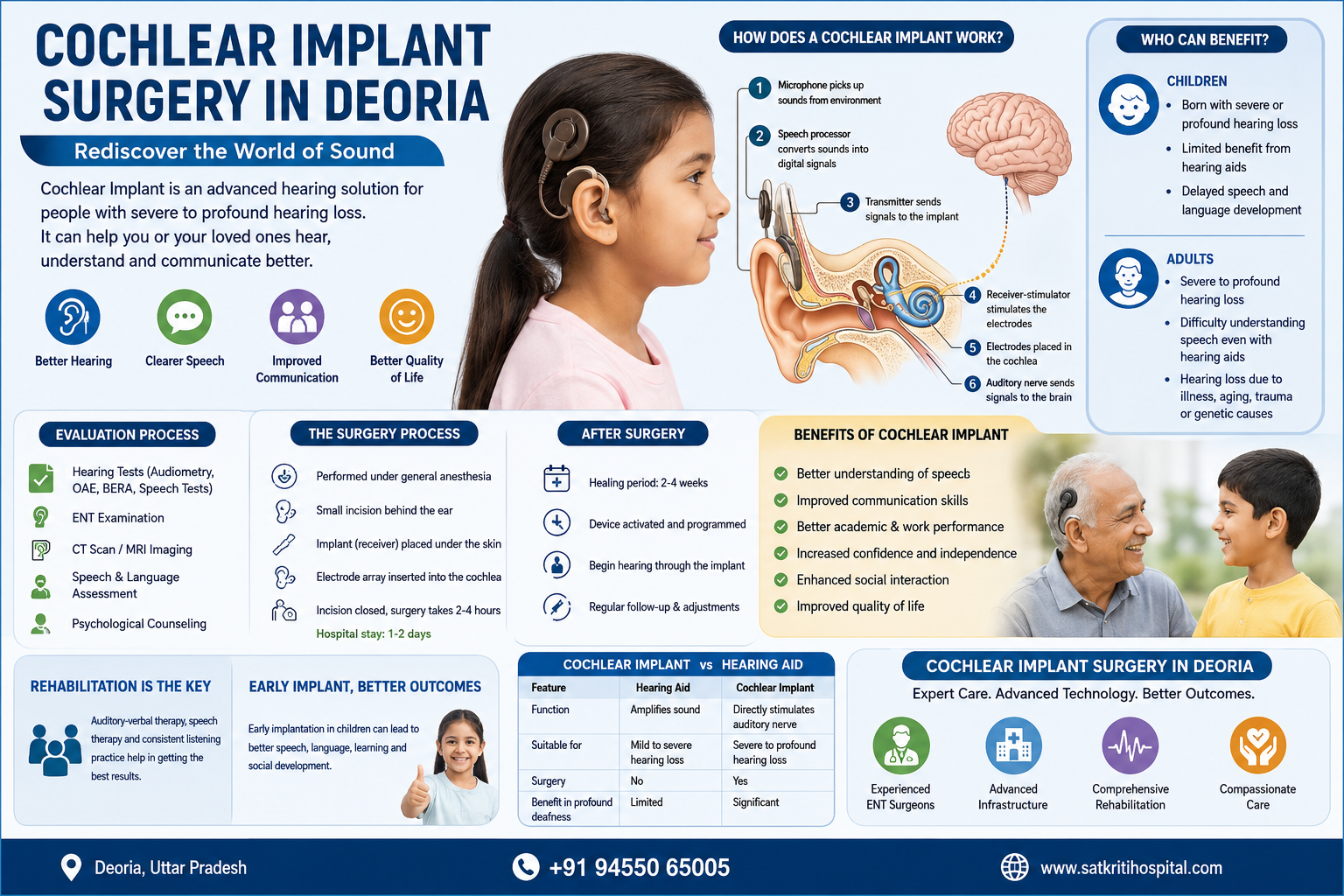
A cochlear implant is an advanced electronic medical device designed to provide a sense of sound to individuals with severe to profound sensorineural hearing loss. Unlike hearing aids, which amplify sounds, a cochlear implant bypasses the damaged part of the inner ear and directly stimulates the auditory nerve.
The device consists of two main components:
External Components
- Microphone
- Speech Processor
- Transmitter Coil
Internal Components
- Receiver-Stimulator
- Electrode Array inserted into the cochlea
Together, these components convert sound into electrical signals that are sent directly to the brain, allowing the person to perceive sound.
Who Needs a Cochlear Implant?
A cochlear implant may be recommended for:
Children
- Born with severe or profound hearing loss.
- Children who receive limited benefit from hearing aids.
- Children with delayed speech and language development due to hearing impairment.
Adults
- Individuals who have lost hearing due to illness, aging, infection, trauma, or genetic causes.
- Adults who struggle to understand speech despite using powerful hearing aids.
- People experiencing progressive hearing loss.
Signs That a Cochlear Implant May Be Needed
Some common signs include:
- Difficulty understanding conversations.
- Frequently asking others to repeat themselves.
- Inability to hear telephone conversations clearly.
- Poor response to hearing aids.
- Delayed speech development in children.
- Difficulty hearing environmental sounds.
If these symptoms are present, a comprehensive hearing evaluation by an ENT specialist and audiologist is necessary.
Causes of Severe Hearing Loss
Several factors can lead to severe hearing loss, including:
Congenital Causes
- Genetic conditions.
- Birth complications.
- Infections during pregnancy such as rubella.
Acquired Causes
- Meningitis.
- Chronic ear infections.
- Exposure to loud noise.
- Head injury.
- Certain medications.
- Age-related hearing loss.
Understanding the underlying cause helps specialists determine whether cochlear implantation is appropriate.
How Does a Cochlear Implant Work?
The process involves several steps:
- The microphone picks up sounds from the environment.
- The speech processor analyzes and converts sounds into digital signals.
- The transmitter sends signals to the implanted receiver.
- The receiver stimulates electrodes placed inside the cochlea.
- The auditory nerve carries these signals to the brain.
- The brain interprets these signals as sound.
Although hearing through a cochlear implant is different from natural hearing initially, most users learn to recognize and understand sounds effectively through rehabilitation.
Benefits of Cochlear Implant Surgery
Improved Speech Understanding
One of the most significant benefits is better speech recognition, even in noisy environments.
Better Communication Skills
Children often develop speech and language skills more effectively after implantation.
Improved Academic Performance
Hearing enables better learning and participation in educational activities.
Enhanced Social Interaction
Users can communicate more confidently with family, friends, and colleagues.
Increased Independence
Adults often regain confidence and independence in daily life.
Better Quality of Life
Many recipients report substantial improvements in emotional well-being and social engagement.
Evaluation Before Cochlear Implant Surgery
Before surgery, patients undergo detailed assessments to determine candidacy.
Audiological Evaluation
Tests include:
- Pure Tone Audiometry
- Otoacoustic Emissions (OAE)
- Brainstem Evoked Response Audiometry (BERA)
- Speech Perception Testing
ENT Examination
An ENT specialist evaluates ear health and medical suitability.
Imaging Studies
CT Scan and MRI are performed to assess inner ear structures.
Speech and Language Assessment
Particularly important for children.
Psychological Counseling
Families and patients receive counseling regarding expectations and rehabilitation.
Cochlear Implant Surgery Procedure
Step 1: Anesthesia
The surgery is performed under general anesthesia.
Step 2: Surgical Incision
A small incision is made behind the ear.
Step 3: Placement of Internal Device
The surgeon places the receiver beneath the skin.
Step 4: Electrode Insertion
The electrode array is carefully inserted into the cochlea.
Step 5: Closure
The incision is closed with sutures.
The surgery generally takes 2 to 4 hours.
Recovery After Surgery
Most patients recover quickly.
Immediately After Surgery
- Mild discomfort around the incision site.
- Temporary dizziness in some patients.
- Hospital stay of one to two days.
Healing Period
The implant remains inactive for approximately 2 to 4 weeks while healing occurs.
Device Activation
After healing, the external processor is fitted and activated.
What Happens During Device Activation?
Activation is one of the most exciting milestones.
During activation:
- The processor is programmed.
- Initial sound levels are adjusted.
- Patients begin hearing sounds through the implant.
Initially, sounds may seem unusual, but the brain gradually adapts.
Importance of Auditory Rehabilitation
Surgery alone is not enough. Rehabilitation is critical for success.
For Children
- Auditory Verbal Therapy (AVT)
- Speech Therapy
- Language Development Programs
For Adults
- Listening exercises
- Speech comprehension training
- Communication strategies
Consistent rehabilitation significantly improves outcomes.
Cochlear Implant for Children
Early implantation often provides the best results.
Advantages of Early Implantation
- Faster speech development.
- Better language acquisition.
- Improved educational outcomes.
- Enhanced social skills.
Experts often recommend implantation at a young age when appropriate.
Cochlear Implant for Adults
Adults can also benefit significantly.
Common Benefits
- Better communication.
- Improved workplace performance.
- Greater participation in social activities.
- Enhanced emotional well-being.
Even individuals who have experienced hearing loss for years may achieve remarkable improvements.
Success Rate of Cochlear Implant Surgery
Cochlear implantation is considered a highly successful procedure worldwide.
Success depends on factors such as:
- Age at implantation.
- Duration of deafness.
- Consistent device usage.
- Quality of rehabilitation.
- Family support.
Most recipients experience substantial improvement in hearing and communication abilities.
Risks Associated with Cochlear Implant Surgery
As with any surgical procedure, there are potential risks, though complications are uncommon.
Possible risks include:
- Infection.
- Bleeding.
- Dizziness.
- Facial nerve injury (rare).
- Device malfunction.
- Tinnitus.
Choosing an experienced cochlear implant team minimizes these risks.
Cochlear Implant vs Hearing Aid
| Feature | Hearing Aid | Cochlear Implant |
|---|---|---|
| Function | Amplifies sound | Directly stimulates auditory nerve |
| Suitable For | Mild to severe hearing loss | Severe to profound hearing loss |
| Surgery Required | No | Yes |
| Benefit in Profound Deafness | Limited | Significant |
| Technology | External device | Internal and external components |
An ENT specialist and audiologist can determine which option is best.
Cost of Cochlear Implant Surgery
The cost of cochlear implantation depends on:
- Implant brand.
- Hospital facilities.
- Surgeon expertise.
- Diagnostic tests.
- Rehabilitation services.
The overall cost may range from several lakhs of rupees, including surgery and post-operative care.
Government Assistance and Financial Support
Many patients may qualify for financial assistance through:
- Government health schemes.
- Disability welfare programs.
- Charitable organizations.
- Corporate social responsibility (CSR) initiatives.
- Hearing health foundations.
Families should inquire about available support programs.
Choosing the Right Cochlear Implant Center
When selecting a cochlear implant center, consider:
Experienced ENT Surgeons
Specialized cochlear implant surgeons improve outcomes.
Qualified Audiologists
Proper programming and rehabilitation are essential.
Comprehensive Rehabilitation Services
Look for centers offering speech and auditory therapy.
Advanced Diagnostic Facilities
Comprehensive evaluation ensures accurate treatment planning.
Long-Term Follow-Up Care
Regular adjustments and monitoring are necessary.
Life After Cochlear Implant Surgery
Most recipients gradually adapt to hearing through their implant.
Daily Activities
Patients can typically:
- Attend school or work.
- Participate in conversations.
- Use telephones.
- Enjoy music.
- Engage in social activities.
Ongoing Care
Regular follow-up visits help optimize hearing performance.
Frequently Asked Questions
Is cochlear implant surgery safe?
Yes. It is a well-established procedure with a high success rate when performed by experienced specialists.
Can both children and adults undergo cochlear implantation?
Yes. Both children and adults with severe hearing loss may benefit.
How long does the implant last?
The internal implant is designed to last many years, often for decades.
Will hearing be normal immediately after activation?
No. The brain requires time and training to adapt to the new sounds.
Is rehabilitation necessary?
Absolutely. Rehabilitation is a key factor in achieving the best hearing outcomes.
Conclusion
Cochlear implant surgery offers hope and a new beginning for individuals living with severe to profound hearing loss. For residents of Deoria, access to expert evaluation, advanced surgical care, and dedicated rehabilitation services can help transform lives through improved hearing and communication.
Whether for a child born with hearing impairment or an adult who has gradually lost hearing, cochlear implantation has the potential to restore connections, improve confidence, and enhance quality of life. Early diagnosis, timely intervention, and commitment to rehabilitation remain the keys to achieving the best possible outcomes.
