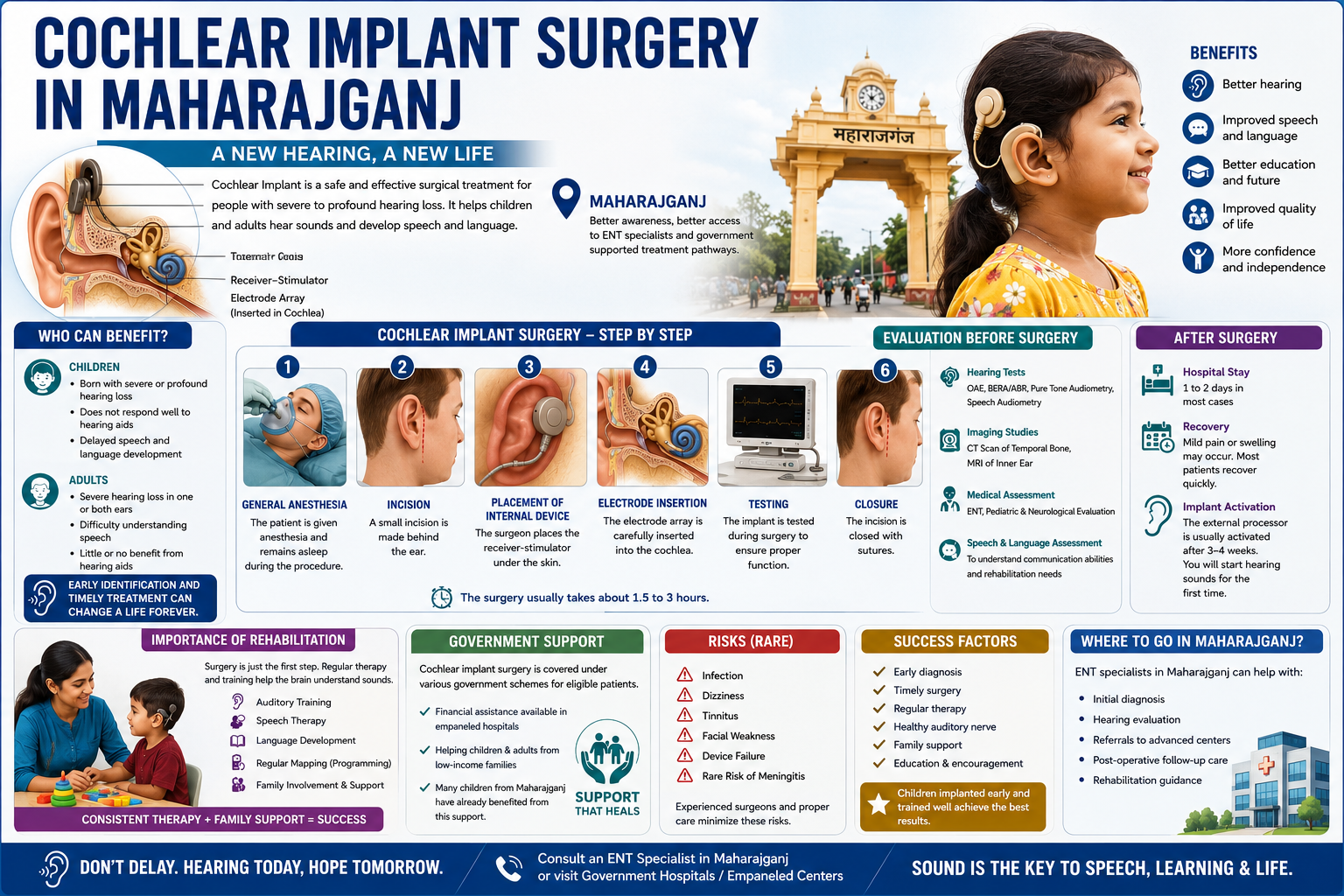
Hearing is one of the most important senses for communication, learning, and social interaction. When a child or adult suffers from severe to profound hearing loss, everyday activities become extremely challenging. Fortunately, modern medical science offers a life-changing solution known as Cochlear Implant Surgery.
For families in Maharajganj, cochlear implant treatment has become increasingly accessible through government schemes, referral centers, and specialized ENT services. Several children from Maharajganj have already benefited from cochlear implant surgery, helping them hear sounds and develop speech abilities.
What is a Cochlear Implant?
A cochlear implant is an electronic medical device designed for people with severe to profound sensorineural hearing loss who receive little or no benefit from hearing aids.
Unlike hearing aids, which simply amplify sounds, a cochlear implant bypasses the damaged part of the inner ear (cochlea) and directly stimulates the auditory nerve, allowing sound signals to reach the brain.
A cochlear implant consists of two parts:
External Components
- Microphone
- Sound processor
- Transmitter coil
- Battery system
Internal Components
- Receiver-stimulator
- Electrode array inserted into the cochlea
These components work together to convert sounds into electrical signals that the brain interprets as hearing.
Who Needs a Cochlear Implant?
A cochlear implant may be recommended for:
Children
- Born with severe or profound hearing loss
- Children who do not respond adequately to hearing aids
- Delayed speech and language development due to hearing impairment
Adults
- Severe hearing loss developed later in life
- Difficulty understanding speech despite hearing aids
- Progressive sensorineural hearing loss
Specialists generally recommend cochlear implants when hearing aids fail to provide sufficient benefit.
Common Causes of Severe Hearing Loss
In Children
- Congenital (birth-related) deafness
- Genetic disorders
- Infections during pregnancy
- Premature birth
- Low birth weight
- Lack of oxygen during delivery
- Neonatal jaundice
In Adults
- Aging
- Noise-induced hearing loss
- Head injury
- Viral infections
- Meningitis
- Ototoxic medications
According to medical experts, congenital deafness affects approximately 4–6 out of every 1,000 newborns in India and Uttar Pradesh. Early diagnosis is crucial for better outcomes.
Signs That a Child May Have Hearing Loss
Parents in Maharajganj should watch for:
Birth to 6 Months
- No reaction to loud sounds
- No startle reflex
- Does not recognize parents’ voices
6 to 12 Months
- No babbling
- Does not turn toward sounds
- Poor response to name
1 to 2 Years
- Delayed speech
- Limited vocabulary
- Difficulty following simple instructions
If these signs are present, an ENT specialist and audiologist should evaluate the child immediately.
Evaluation Before Cochlear Implant Surgery
Before surgery, patients undergo a comprehensive assessment.
Hearing Tests
- OAE (Otoacoustic Emissions)
- BERA/ABR
- Pure Tone Audiometry
- Speech Audiometry
Imaging Studies
- CT Scan of Temporal Bone
- MRI of Inner Ear and Auditory Nerve
Medical Assessment
- ENT examination
- Pediatric evaluation
- Neurological assessment if required
Speech and Language Assessment
Audiologists and speech therapists assess the patient’s communication abilities and rehabilitation needs.
Comprehensive hearing assessments are considered an essential step before cochlear implantation.
Cochlear Implant Surgery Procedure
Step 1: General Anesthesia
The patient is given anesthesia and remains asleep throughout the procedure.
Step 2: Incision Behind the Ear
A small incision is made behind the ear.
Step 3: Placement of Internal Device
The surgeon places the receiver-stimulator beneath the skin.
Step 4: Electrode Insertion
The electrode array is carefully inserted into the cochlea.
Step 5: Testing
The implant is tested during surgery.
Step 6: Closure
The incision is closed with sutures.
The surgery generally takes about 1.5 to 3 hours, depending on the complexity of the case.
What Happens After Surgery?
Patients usually stay in the hospital for one or two days.
Recovery Phase
- Mild pain and swelling may occur
- Most patients recover quickly
- Regular follow-up visits are scheduled
Implant Activation
The external processor is generally activated several weeks after surgery.
At activation, the patient begins hearing sounds through the implant for the first time.
Importance of Speech Therapy and Rehabilitation
Surgery alone is not enough.
After activation, patients require:
- Auditory training
- Speech therapy
- Language development sessions
- Regular implant programming (mapping)
The brain needs time to learn how to interpret the new sound signals.
Children implanted early and provided with consistent therapy often achieve remarkable improvements in speech and language development.
Benefits of Cochlear Implant Surgery
For Children
- Better speech development
- Improved language skills
- Enhanced educational opportunities
- Better social interaction
- Increased confidence
For Adults
- Improved communication
- Better understanding of speech
- Greater independence
- Enhanced quality of life
Many cochlear implant users achieve significant improvements in hearing and speech understanding after rehabilitation.
Risks and Complications
Although cochlear implant surgery is considered safe, potential risks include:
- Infection
- Dizziness
- Tinnitus
- Temporary facial weakness
- Device failure
- Rare risk of meningitis
Experienced surgeons minimize these risks through careful planning and modern surgical techniques.
Cochlear Implant Success Rate
The success of cochlear implantation depends on:
- Age at implantation
- Duration of deafness
- Auditory nerve health
- Regular speech therapy
- Family involvement
Children implanted at younger ages generally achieve the best outcomes because the brain develops speech and language more effectively during early childhood.
Cochlear Implant Facilities for Maharajganj Residents
While advanced cochlear implant surgeries are usually performed in specialized centers in larger cities such as Gorakhpur, Lucknow, and other tertiary care hospitals, ENT specialists in Maharajganj can help with:
- Initial diagnosis
- Hearing evaluation
- Referrals
- Post-operative follow-up care
A specialist ENT service is available in Maharajganj through local healthcare facilities, including ENT consultation services.
Government Support and Financial Assistance
One of the biggest concerns for families is the cost.
Several government programs and disability support schemes help eligible patients receive cochlear implant surgery.
Institutions empaneled under government-supported programs provide cochlear implant surgery and rehabilitation support for eligible beneficiaries.
Recent reports from Maharajganj indicate that numerous children have already received cochlear implant surgery with government assistance, helping restore access to sound and speech development.
Life After Cochlear Implant
The journey does not end with surgery.
Successful outcomes require:
- Regular device maintenance
- Periodic mapping sessions
- Consistent speech therapy
- Family support
- School integration
Most patients gradually improve their ability to recognize sounds, understand speech, and communicate effectively over time.
Conclusion
Cochlear implant surgery is one of the most transformative treatments available for individuals with severe to profound hearing loss. For children born deaf and adults who have lost their hearing, it offers an opportunity to reconnect with the world of sound.
Families in Maharajganj now have greater awareness, better access to ENT specialists, and government-supported pathways for cochlear implant treatment. Early diagnosis, timely surgery, and dedicated rehabilitation can significantly improve hearing, speech, education, and overall quality of life.
The sooner hearing loss is identified and treated, the better the chances of achieving successful long-term outcomes.
