Hearing plays a vital role in communication, education, social interaction, and overall quality of life. When hearing loss becomes severe or profound, conventional hearing aids may no longer provide sufficient benefit. In such situations, cochlear implant surgery offers a revolutionary solution that can help individuals regain access to sound and improve their ability to communicate.
For residents of Balrampur and nearby regions, cochlear implant surgery has become a life-changing option for both children and adults suffering from significant hearing impairment. This comprehensive guide explains everything you need to know about cochlear implants, including who can benefit, the surgical procedure, recovery, costs, advantages, and long-term outcomes.
What is a Cochlear Implant?
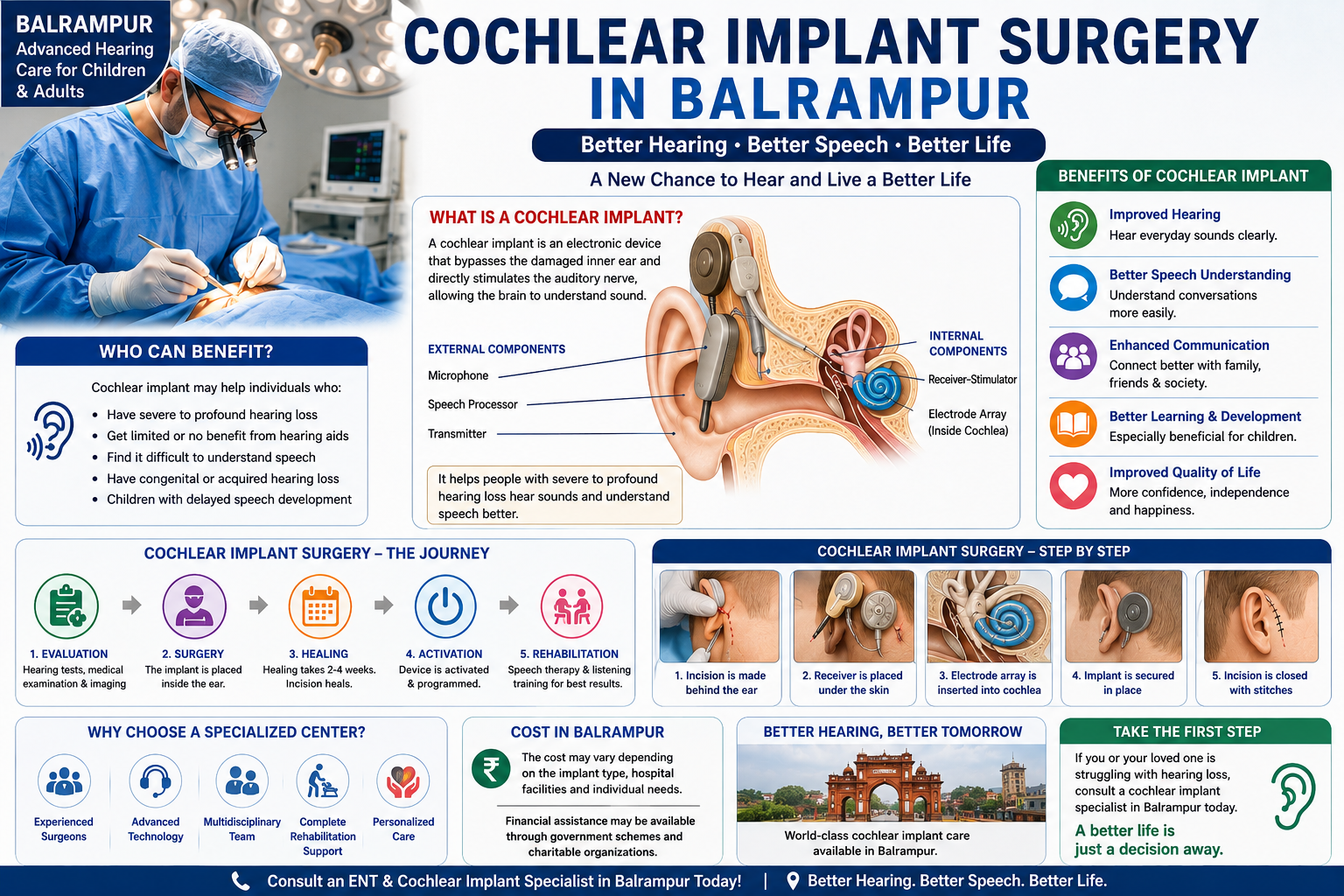
A cochlear implant is an advanced electronic medical device designed to provide a sense of sound to people with severe to profound sensorineural hearing loss.
Unlike hearing aids, which amplify sound, a cochlear implant bypasses the damaged portions of the inner ear and directly stimulates the auditory nerve. These electrical signals are then transmitted to the brain, which interprets them as sound.
A cochlear implant consists of two major parts:
External Components
- Microphone
- Speech Processor
- Transmitting Coil
Internal Components
- Receiver-Stimulator
- Electrode Array inserted into the cochlea
Together, these components help individuals hear and understand speech more effectively.
Understanding Hearing Loss
Hearing loss can affect people of all ages, from newborns to elderly individuals.
Types of Hearing Loss
Conductive Hearing Loss
Occurs when sound cannot efficiently pass through the outer or middle ear.
Sensorineural Hearing Loss
Results from damage to the inner ear or auditory nerve.
Mixed Hearing Loss
A combination of conductive and sensorineural hearing loss.
Cochlear implants are primarily used for severe to profound sensorineural hearing loss.
Causes of Severe Hearing Loss
In Children
Many children are born with hearing impairment or develop it shortly after birth.
Common causes include:
- Genetic conditions
- Congenital infections
- Premature birth
- Birth complications
- Meningitis
- High fever
- Neonatal jaundice
- Low birth weight
In Adults
Hearing loss may develop later in life due to:
- Aging
- Chronic ear infections
- Noise exposure
- Head injuries
- Viral infections
- Ototoxic medications
- Hereditary factors
When hearing aids no longer provide adequate improvement, cochlear implantation may be recommended.
Who is a Candidate for Cochlear Implant Surgery?
Not everyone with hearing loss requires a cochlear implant.
Candidates typically include:
Children
- Severe to profound hearing loss
- Limited benefit from hearing aids
- Delayed speech development
- Congenital deafness
Adults
- Severe hearing impairment
- Poor speech understanding despite hearing aids
- Progressive hearing loss
- Sudden profound hearing loss
A detailed assessment is necessary to determine eligibility.
Signs Your Child May Need a Cochlear Implant
Parents should seek medical evaluation if their child:
- Does not respond to sounds
- Does not react to their name
- Has delayed speech development
- Frequently appears unaware of surrounding sounds
- Shows minimal benefit from hearing aids
Early diagnosis significantly improves outcomes.
Why Early Intervention is Important
The human brain develops rapidly during early childhood.
The first few years of life are critical for:
- Speech development
- Language learning
- Auditory processing
- Social interaction
Children who receive cochlear implants at an early age often develop speech and language skills more effectively than those implanted later.
Benefits of Cochlear Implant Surgery
Cochlear implants offer numerous life-changing benefits.
Improved Hearing Ability
Recipients gain access to sounds they were previously unable to hear, including:
- Voices
- Doorbells
- Traffic sounds
- Mobile phone rings
- Environmental sounds
Better Speech Understanding
Many recipients can understand conversations more clearly, even in challenging listening environments.
Enhanced Communication Skills
Improved hearing helps children and adults communicate more effectively with family, friends, teachers, and colleagues.
Better Educational Opportunities
Children with cochlear implants often perform better academically because they can access spoken language more easily.
Greater Independence
Adults frequently report increased confidence and independence after implantation.
Improved Quality of Life
The ability to hear can positively affect emotional well-being, relationships, and social participation.
Cochlear Implant Evaluation Process
Before surgery, patients undergo a comprehensive assessment.
Hearing Tests
Common tests include:
- Pure Tone Audiometry
- Otoacoustic Emissions (OAE)
- Brainstem Evoked Response Audiometry (BERA)
- Speech Recognition Tests
Hearing Aid Assessment
Doctors evaluate whether hearing aids are providing adequate benefit.
Imaging Studies
CT Scan
Used to examine the structure of the cochlea.
MRI Scan
Assesses the auditory nerve and inner ear anatomy.
Speech and Language Evaluation
Particularly important for children.
Medical Examination
The ENT specialist determines whether the patient is medically fit for surgery.
How Cochlear Implant Surgery is Performed
The procedure is generally performed under general anesthesia.
Surgical Steps
- The patient is given anesthesia.
- A small incision is made behind the ear.
- The surgeon accesses the inner ear.
- The electrode array is inserted into the cochlea.
- The receiver is placed beneath the skin.
- The incision is closed.
The operation usually takes between two and four hours.
Is Cochlear Implant Surgery Safe?
Yes. Cochlear implantation is a well-established and safe procedure performed worldwide.
Possible risks include:
- Infection
- Temporary dizziness
- Tinnitus
- Device malfunction
- Temporary facial nerve weakness
Complications are uncommon when performed by experienced surgeons.
Recovery After Surgery
Most patients recover quickly following cochlear implant surgery.
Immediately After Surgery
Patients may experience:
- Mild discomfort
- Slight swelling around the incision
- Temporary dizziness
Hospital Stay
Most patients stay in the hospital for one to two days.
Healing Period
The surgical site generally heals within two to four weeks.
Cochlear Implant Activation
The implant is not activated immediately after surgery.
Typically, activation occurs three to four weeks later once healing is complete.
During activation:
- The speech processor is connected.
- The audiologist programs the device.
- Initial hearing responses are evaluated.
Many patients hear sounds for the first time during this appointment.
What Does Hearing Sound Like Initially?
Initially, sounds may seem:
- Mechanical
- Robotic
- Unusual
However, with time and practice, the brain adapts and learns to interpret sounds more naturally.
Most recipients experience continuous improvement over several months.
Importance of Auditory Rehabilitation
Rehabilitation is one of the most important aspects of cochlear implant success.
Rehabilitation Includes
- Speech therapy
- Listening exercises
- Auditory training
- Language development programs
Regular therapy helps recipients maximize the benefits of their implant.
Cochlear Implants for Children
Children often achieve remarkable outcomes when implanted early.
Benefits include:
- Better speech development
- Improved language acquisition
- Enhanced educational performance
- Greater social confidence
Early intervention is often the key to long-term success.
Cochlear Implants for Adults
Adults can also experience significant improvements.
Benefits include:
- Better communication
- Improved workplace performance
- Increased social interaction
- Enhanced safety awareness
- Greater independence
Even adults who have experienced hearing loss for many years may benefit.
Single-Sided Deafness and Cochlear Implants
Some individuals have profound hearing loss in only one ear.
Modern cochlear implants can help such patients by:
- Improving sound localization
- Enhancing hearing in noisy environments
- Reducing listening effort
This has expanded the range of patients who may benefit from implantation.
Modern Cochlear Implant Technology
Today’s cochlear implants are highly advanced.
Features may include:
- Bluetooth connectivity
- Smartphone compatibility
- Wireless accessories
- Noise reduction technology
- Water-resistant processors
- Improved speech clarity
These innovations help recipients achieve better hearing outcomes.
Cost of Cochlear Implant Surgery in Balrampur
The total cost depends on several factors, including:
- Implant brand
- Surgical expertise
- Hospital facilities
- Diagnostic investigations
- Rehabilitation services
In India, cochlear implant surgery generally costs several lakhs of rupees.
The exact amount varies from case to case.
Financial Assistance and Government Support
Many eligible patients may receive support through:
- Government health schemes
- Disability welfare programs
- Charitable organizations
- CSR-funded initiatives
- Cochlear implant assistance programs
Families should consult cochlear implant centers regarding available funding opportunities.
Life After Cochlear Implant Surgery
Most recipients experience dramatic improvements in daily life.
They may be able to:
- Communicate more effectively
- Participate in conversations
- Attend mainstream schools
- Use telephones
- Enjoy music
- Engage confidently in social situations
Continued follow-up and rehabilitation are essential for achieving the best results.
Frequently Asked Questions
Can a child born deaf learn to speak after cochlear implantation?
Yes. Many children develop excellent speech and language skills with early implantation and proper therapy.
Is cochlear implant surgery painful?
The procedure is performed under anesthesia, and postoperative discomfort is usually mild.
How long does the implant last?
The internal device is designed to last for many years, often several decades.
Will hearing become completely normal?
Cochlear implants do not restore natural hearing but provide meaningful access to sound and speech.
Is speech therapy necessary?
Yes. Rehabilitation plays a crucial role in maximizing outcomes.
Can adults benefit from cochlear implants?
Absolutely. Many adults achieve substantial improvements in communication and quality of life.
Conclusion
Cochlear implant surgery has transformed the lives of thousands of individuals with severe hearing loss. For patients in Balrampur and surrounding areas, this advanced technology offers hope, improved communication, and a better future.
Whether a child is born with hearing impairment or an adult experiences progressive hearing loss, cochlear implants can provide access to sound, speech, education, and social interaction. Early diagnosis, timely intervention, expert surgical care, and dedicated rehabilitation are the foundation of successful cochlear implantation.
With modern technology and specialized hearing care, cochlear implant surgery continues to empower individuals to hear better, communicate confidently, and live fuller lives.
