Hearing is one of the most important senses that helps us communicate, learn, and connect with the world around us. When a person suffers from severe to profound hearing loss, even powerful hearing aids may not provide enough benefit. In such situations, Cochlear Implant Surgery can be a life-changing solution.
For families in Jaunpur and nearby districts of Eastern Uttar Pradesh, awareness about cochlear implants is increasing rapidly. Many children born with severe hearing loss and adults who have lost their hearing later in life are now benefiting from this advanced technology.
This comprehensive guide explains everything about cochlear implant surgery, including who needs it, how it works, the surgical procedure, benefits, risks, recovery process, cost, and the availability of treatment for patients from Jaunpur.
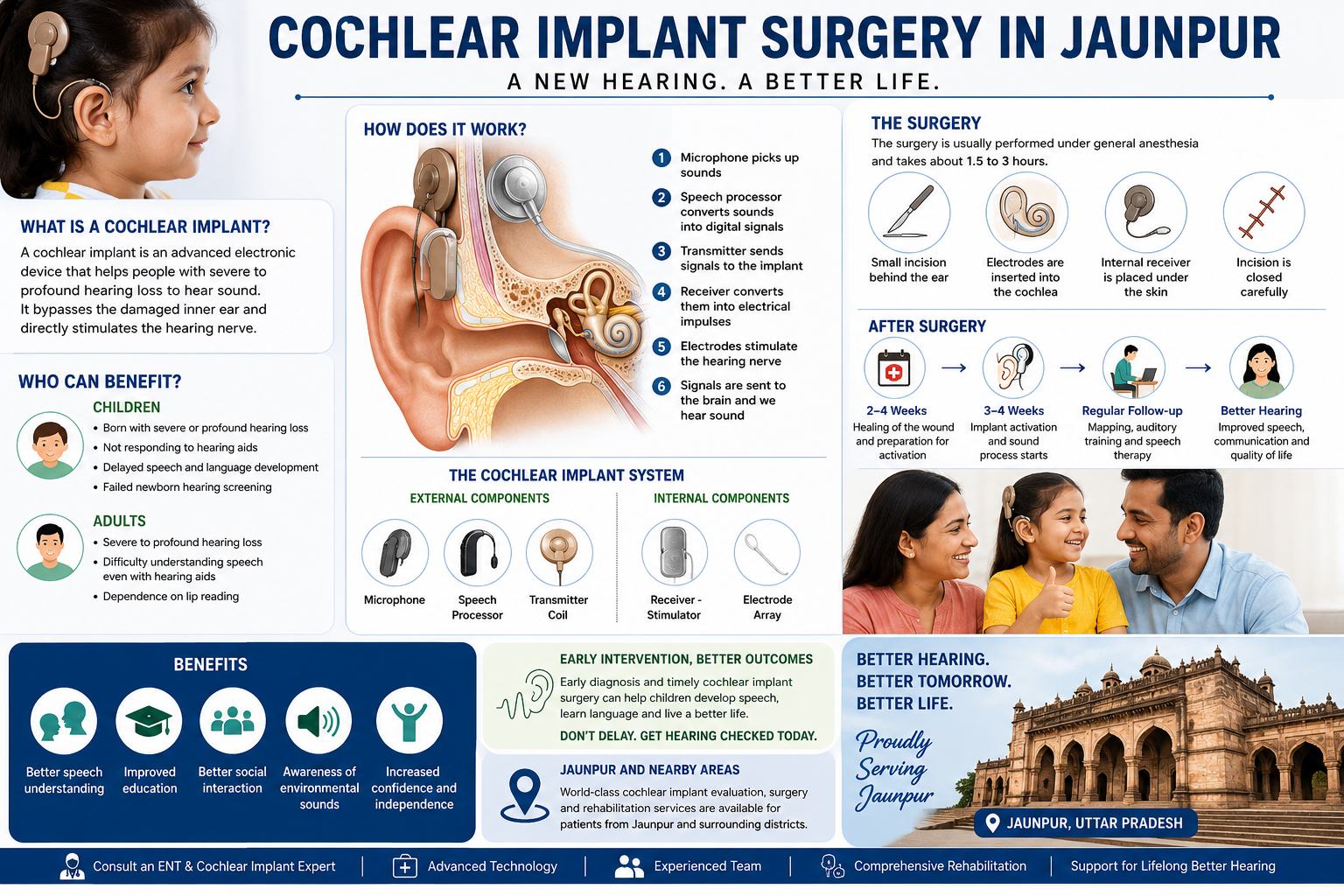
What is a Cochlear Implant?
A cochlear implant is a small electronic medical device designed for people with severe to profound sensorineural hearing loss who receive little or no benefit from hearing aids. Unlike hearing aids, which simply amplify sounds, a cochlear implant bypasses the damaged inner ear structures and directly stimulates the hearing nerve, allowing sound signals to reach the brain.
A cochlear implant consists of two main parts:
External Components
- Microphone
- Speech Processor
- Transmitter Coil
Internal Components
- Receiver-Stimulator
- Electrode Array inserted into the cochlea
These components work together to convert sound into electrical signals that the brain interprets as hearing.
How Does a Cochlear Implant Work?
The process works as follows:
- The microphone picks up sounds from the environment.
- The speech processor converts these sounds into digital signals.
- The transmitter sends these signals to the implanted receiver.
- The receiver converts them into electrical impulses.
- Electrodes inside the cochlea stimulate the auditory nerve.
- The auditory nerve carries these signals to the brain.
- The brain recognizes these signals as meaningful sounds and speech.
Although hearing through a cochlear implant is different from natural hearing initially, most recipients gradually learn to understand speech and environmental sounds effectively through rehabilitation.
Who Needs Cochlear Implant Surgery?
A cochlear implant may be recommended for:
Children
- Born with severe or profound hearing loss
- Not responding adequately to hearing aids
- Delayed speech and language development
- Failed newborn hearing screening
Adults
- Severe to profound hearing loss
- Difficulty understanding speech despite hearing aids
- Dependence on lip reading
- Progressive hearing loss affecting communication
Experts generally recommend cochlear implants when hearing aids no longer provide sufficient speech understanding.
Common Causes of Severe Hearing Loss
In Children
- Genetic factors
- Infections during pregnancy
- Premature birth
- Birth complications
- Neonatal jaundice
- Meningitis
In Adults
- Age-related hearing loss
- Viral infections
- Head injury
- Ototoxic medications
- Sudden sensorineural hearing loss
- Genetic disorders
Signs That a Child May Need Evaluation
Parents in Jaunpur should consult an ENT specialist if a child:
- Does not respond to sounds
- Does not turn toward voices
- Has delayed speech development
- Frequently increases television volume
- Cannot understand spoken words properly
- Does not react to loud noises
Early diagnosis is extremely important because the brain develops speech and language pathways most effectively during the first few years of life.
Benefits of Cochlear Implant Surgery
Many recipients experience significant improvements in communication and quality of life.
Benefits for Children
- Improved speech development
- Better language learning
- Improved educational performance
- Enhanced social interaction
- Better confidence
Benefits for Adults
- Better speech understanding
- Improved communication
- Reduced dependence on lip reading
- Improved telephone conversations
- Better awareness of environmental sounds
- Increased confidence in social situations
Many patients report being able to hear everyday sounds such as doorbells, footsteps, alarms, and conversations more clearly after successful implantation and rehabilitation.
Cochlear Implant vs Hearing Aid
| Feature | Hearing Aid | Cochlear Implant |
|---|---|---|
| Method | Amplifies sound | Electrically stimulates auditory nerve |
| Surgery Required | No | Yes |
| Best For | Mild to moderate hearing loss | Severe to profound hearing loss |
| Speech Clarity | Limited in severe loss | Often significantly improved |
| Internal Device | No | Yes |
Hearing aids make sounds louder, whereas cochlear implants create a new hearing pathway by bypassing damaged inner ear structures.
Evaluation Before Cochlear Implant Surgery
Before surgery, a detailed assessment is performed.
Hearing Tests
- Pure Tone Audiometry
- Speech Audiometry
- OAE
- BERA/ABR
Medical Evaluation
- ENT examination
- General health assessment
Imaging
- CT Scan
- MRI Scan
Speech and Language Assessment
Psychological Counseling
These evaluations determine whether the patient is an appropriate candidate for implantation.
Cochlear Implant Surgery Procedure
The surgery is usually performed under general anesthesia.
Step-by-Step Procedure
- Patient is given anesthesia.
- A small incision is made behind the ear.
- The surgeon creates access to the cochlea.
- Electrodes are inserted into the cochlea.
- The internal receiver is secured beneath the skin.
- The incision is closed carefully.
The procedure generally takes around 1.5 to 3 hours depending on the case.
What Happens After Surgery?
Immediately after surgery:
- Mild swelling may occur.
- Temporary discomfort is common.
- Most patients recover quickly.
- The implant is not activated immediately.
The external processor is usually fitted and activated a few weeks after surgery once healing is complete.
Activation and Mapping
Activation is one of the most exciting milestones.
During activation:
- The speech processor is connected.
- The implant is switched on.
- Initial sound levels are adjusted.
Patients often describe the first sounds as unusual, robotic, or electronic. Over time, the brain adapts and speech understanding improves significantly.
Importance of Auditory Rehabilitation
Surgery alone is not enough.
Success depends heavily on:
- Auditory training
- Speech therapy
- Regular mapping sessions
- Family involvement
- Consistent device use
Experts emphasize that rehabilitation is essential for optimal outcomes.
Risks of Cochlear Implant Surgery
Cochlear implant surgery is generally considered safe, but like any surgery, risks exist.
Possible complications include:
- Infection
- Bleeding
- Dizziness
- Balance issues
- Facial nerve weakness
- Taste disturbances
- Tinnitus
- Device failure
- Meningitis (rare)
- Loss of residual hearing in the implanted ear
Proper vaccination and expert surgical care significantly reduce these risks.
Recovery Timeline
First Week
- Mild discomfort
- Rest and wound care
2–4 Weeks
- Healing of surgical site
- Preparation for activation
First 6 Months
- Rapid hearing improvements
- Regular mapping sessions
- Speech therapy
1 Year and Beyond
- Continued improvement in listening and communication skills
Many patients experience substantial improvement within the first six months, though progress continues for years.
Cochlear Implant Outcomes
Results vary depending on:
- Age at implantation
- Duration of deafness
- Cause of hearing loss
- Rehabilitation participation
- Family support
Children implanted at younger ages generally achieve better speech and language outcomes because the brain is still developing auditory pathways.
Cochlear Implant Surgery for Children in Jaunpur
For children from Jaunpur, early intervention is critical.
Parents should seek evaluation if:
- Speech is delayed.
- The child does not respond to sounds.
- Hearing aids provide limited benefit.
Early implantation can significantly improve educational and social outcomes.
Cochlear Implant Surgery for Adults in Jaunpur
Adults who have gradually lost hearing often regain communication confidence through cochlear implantation.
Many adult recipients report:
- Better conversation understanding
- Improved workplace communication
- Greater independence
- Enhanced social participation
However, realistic expectations and commitment to rehabilitation remain important.
Real-World Experiences
Many cochlear implant users share that while hearing is not immediately “normal,” speech understanding improves significantly over time with practice and rehabilitation. Common concerns before surgery include fear of risks, uncertainty about outcomes, and adjustment to new sounds. Community experiences consistently highlight the importance of patience and ongoing therapy.
Cost of Cochlear Implant Surgery
The cost varies depending on:
- Implant brand
- Hospital charges
- Surgeon fees
- Audiology services
- Rehabilitation requirements
Government schemes, insurance coverage, charitable organizations, and health programs may help reduce the financial burden for eligible families.
Why Early Treatment Matters
Untreated severe hearing loss can lead to:
- Speech delay
- Educational difficulties
- Social isolation
- Reduced quality of life
Early diagnosis and timely intervention offer the best opportunity for successful hearing and communication outcomes.
Conclusion
Cochlear implant surgery is one of the most remarkable advances in hearing restoration technology. For children and adults in Jaunpur suffering from severe to profound hearing loss, it offers hope, improved communication, and a better quality of life.
The journey involves careful evaluation, surgery, activation, mapping, and rehabilitation. While it requires commitment and patience, the long-term benefits can be life-changing. If hearing aids are no longer providing sufficient benefit, consulting an experienced cochlear implant team can be the first step toward a world of sound and communication.
