Hearing is one of the most important senses that helps us communicate, learn, and connect with the world around us. For individuals suffering from severe to profound hearing loss, conventional hearing aids may not provide sufficient benefit. In such cases, Cochlear Implant Surgery offers a life-changing solution by restoring access to sound and speech.
Varanasi has emerged as a leading destination for cochlear implant surgery in Eastern Uttar Pradesh and nearby states such as Bihar, Jharkhand, and Madhya Pradesh. With experienced ENT surgeons, advanced audiology services, and comprehensive rehabilitation programs, patients can now receive world-class hearing care closer to home.
This guide covers everything you need to know about cochlear implant surgery in Varanasi, including its benefits, eligibility, procedure, cost, recovery, and outcomes.
What is a Cochlear Implant?
A cochlear implant is an advanced electronic medical device designed for individuals with severe to profound sensorineural hearing loss who receive limited benefit from hearing aids.
Unlike hearing aids, which amplify sound, a cochlear implant bypasses the damaged parts of the inner ear and directly stimulates the auditory nerve. The brain then interprets these signals as sound.
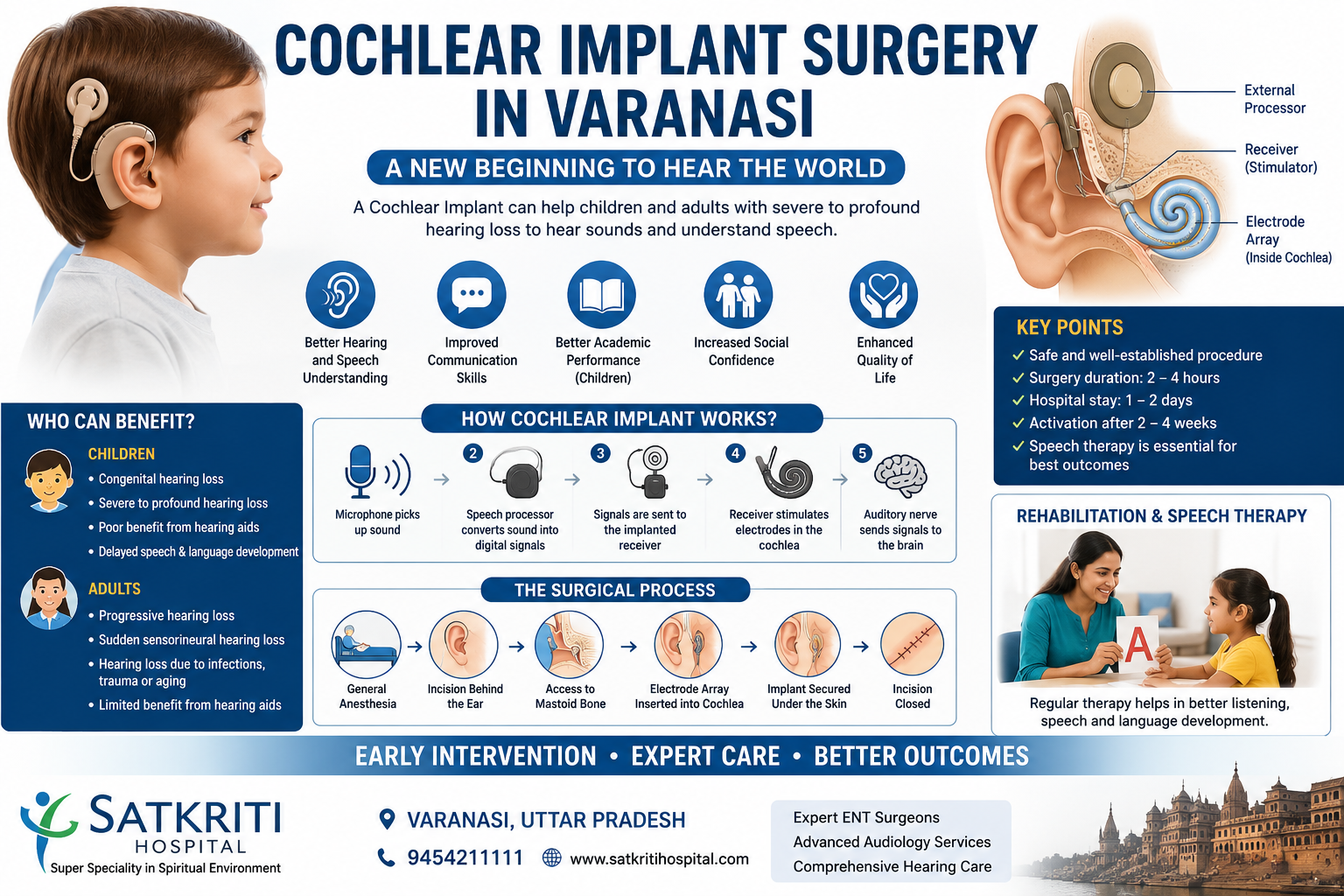
The device consists of two main parts:
External Components
- Microphone
- Speech Processor
- Transmitter Coil
Internal Components
- Receiver-Stimulator
- Electrode Array inserted into the cochlea
Together, these components help users perceive sounds, understand speech, and improve communication abilities.
How Does a Cochlear Implant Work?
The cochlear implant system works through the following steps:
- The microphone captures sounds from the environment.
- The speech processor converts sounds into digital signals.
- The transmitter sends these signals to the implanted receiver.
- The receiver stimulates electrodes inside the cochlea.
- The auditory nerve carries the signals to the brain.
- The brain interprets these signals as meaningful sounds.
This technology enables individuals with severe hearing loss to hear speech, environmental sounds, and participate more effectively in daily life.
Who Needs Cochlear Implant Surgery?
A cochlear implant may be recommended for:
Children
- Congenital hearing loss (born deaf)
- Severe to profound hearing impairment
- Poor response to hearing aids
- Delayed speech and language development
Adults
- Progressive hearing loss
- Sudden sensorineural hearing loss
- Hearing loss due to infections, trauma, or aging
- Inability to understand speech despite using hearing aids
Early diagnosis and intervention are crucial, especially in children, as the first few years of life are critical for speech and language development.
Signs That a Child May Need Cochlear Implant Evaluation
Parents should seek evaluation if a child:
- Does not respond to sounds
- Does not startle to loud noises
- Has delayed speech development
- Does not recognize parents’ voices
- Shows poor communication skills
- Frequently increases TV volume
Early hearing screening can significantly improve outcomes.
Benefits of Cochlear Implant Surgery
Cochlear implants offer numerous benefits, including:
Improved Speech Understanding
Patients can better understand conversations even in noisy environments.
Better Communication Skills
Children develop speech and language abilities more effectively.
Enhanced Academic Performance
Improved hearing helps children perform better in school.
Increased Social Confidence
Users can interact more confidently with family and friends.
Better Quality of Life
Patients experience greater independence and participation in daily activities.
Access to Environmental Sounds
Users can hear alarms, doorbells, traffic sounds, and other important environmental cues.
Cochlear Implant Surgery in Varanasi
Varanasi has become a major center for cochlear implant treatment due to:
- Experienced ENT surgeons
- Advanced audiology departments
- Modern diagnostic facilities
- Speech and language rehabilitation services
- Long-term follow-up care
- Accessibility for patients from Eastern UP and Bihar
Patients no longer need to travel to metropolitan cities for quality cochlear implant services.
Pre-Surgery Evaluation
Before surgery, a detailed assessment is conducted to determine candidacy.
Audiological Evaluation
- Pure Tone Audiometry
- OAE Testing
- BERA/ABR Testing
- Speech Audiometry
Medical Evaluation
ENT specialists assess the overall condition of the ear and hearing system.
Imaging Studies
- CT Scan of Temporal Bone
- MRI of Inner Ear
Speech and Language Assessment
Evaluates communication abilities and rehabilitation needs.
Psychological Counseling
Families receive counseling regarding realistic expectations and outcomes.
Cochlear Implant Surgery Procedure
The surgery is typically performed under general anesthesia.
Step 1: Preparation
The patient is admitted and prepared for surgery.
Step 2: Incision
A small incision is made behind the ear.
Step 3: Accessing the Cochlea
The surgeon carefully reaches the cochlea through the mastoid bone.
Step 4: Electrode Insertion
The electrode array is inserted into the cochlea.
Step 5: Internal Device Placement
The receiver-stimulator is secured beneath the skin.
Step 6: Closure
The incision is closed with sutures.
The procedure usually takes 2 to 4 hours.
Is Cochlear Implant Surgery Safe?
Yes. Cochlear implant surgery is considered a safe and well-established procedure with high success rates worldwide.
Potential risks may include:
- Infection
- Dizziness
- Facial nerve weakness (rare)
- Device malfunction (rare)
- Temporary taste disturbances
Most patients recover without major complications.
Recovery After Surgery
Recovery is generally smooth.
Immediately After Surgery
- Mild discomfort around the incision site
- Temporary dizziness
- Hospital stay of 1–2 days
First Few Weeks
- Wound healing
- Follow-up consultations
Activation
The implant is usually activated 2–4 weeks after surgery.
Cochlear Implant Activation
Activation is one of the most exciting milestones.
During activation:
- The speech processor is fitted.
- The device is programmed.
- Initial sound perception begins.
For many patients, hearing sounds for the first time is a life-changing experience.
Importance of Speech Therapy
Surgery alone does not guarantee successful outcomes.
Speech therapy and auditory rehabilitation are essential components of cochlear implant treatment.
Benefits of Rehabilitation
- Speech development
- Listening skills
- Language acquisition
- Improved communication
Children often require regular therapy sessions for several months or years.
Outcomes of Cochlear Implant Surgery
Outcomes vary depending on:
- Age at implantation
- Duration of deafness
- Consistency of device usage
- Family involvement
- Quality of rehabilitation
Children
Children implanted early often develop speech and language skills comparable to their hearing peers.
Adults
Most adults experience:
- Improved speech understanding
- Better communication
- Enhanced social participation
Ideal Age for Cochlear Implant Surgery
Research shows that earlier implantation leads to better outcomes.
Recommended Age
- As early as 9–12 months for eligible children
- Before 5 years of age whenever possible
However, older children and adults can also benefit significantly.
Bilateral vs Unilateral Cochlear Implant
Unilateral Implant
Implant in one ear.
Bilateral Implant
Implants in both ears.
Benefits of bilateral implantation include:
- Better sound localization
- Improved hearing in noisy environments
- Enhanced speech understanding
The choice depends on medical and financial considerations.
Cost of Cochlear Implant Surgery in Varanasi
The cost varies depending on:
- Implant brand
- Hospital charges
- Surgeon fees
- Diagnostic tests
- Rehabilitation services
Generally, cochlear implant surgery in India may range from ₹6 lakh to ₹15 lakh or more depending on the device selected.
Many government schemes, NGOs, and charitable organizations provide financial assistance for eligible children.
Government Support for Cochlear Implant Surgery
Several initiatives help children access cochlear implant treatment.
These may include:
- State government programs
- National health schemes
- CSR-supported projects
- NGO assistance programs
Families should inquire about available funding options during consultation.
Choosing the Right Cochlear Implant Center in Varanasi
Consider the following factors:
Experienced ENT Surgeons
Look for specialists with extensive cochlear implant experience.
Comprehensive Audiology Services
A strong audiology department is essential.
Speech Therapy Support
Post-operative rehabilitation significantly influences outcomes.
Long-Term Follow-Up
Regular mapping and adjustments are necessary.
Patient Success Stories
Previous successful cases reflect the center’s expertise.
Frequently Asked Questions
Can a cochlear implant completely restore normal hearing?
No. It does not restore natural hearing but provides access to sound and speech, often with remarkable improvement.
Will my child speak normally after surgery?
Many children implanted early and enrolled in regular speech therapy develop excellent speech and language skills.
How long does the implant last?
The internal implant is designed to last for many years, often decades.
Is the surgery painful?
Most patients experience only mild discomfort after surgery.
Can adults benefit from cochlear implants?
Yes. Adults with severe hearing loss often experience significant improvements in communication and quality of life.
Conclusion
Cochlear implant surgery has transformed the lives of thousands of children and adults with severe hearing loss. With advancements in technology, skilled surgeons, and comprehensive rehabilitation programs, Varanasi has become an important center for cochlear implant treatment in North India.
Early diagnosis, timely intervention, and dedicated speech therapy are the keys to achieving the best outcomes. If you or your child suffers from severe hearing loss and hearing aids are no longer effective, a cochlear implant evaluation may be the first step toward a world filled with sound, speech, and new opportunities.
The journey from silence to sound is possible—and cochlear implants continue to make that journey a reality for countless families every year.
