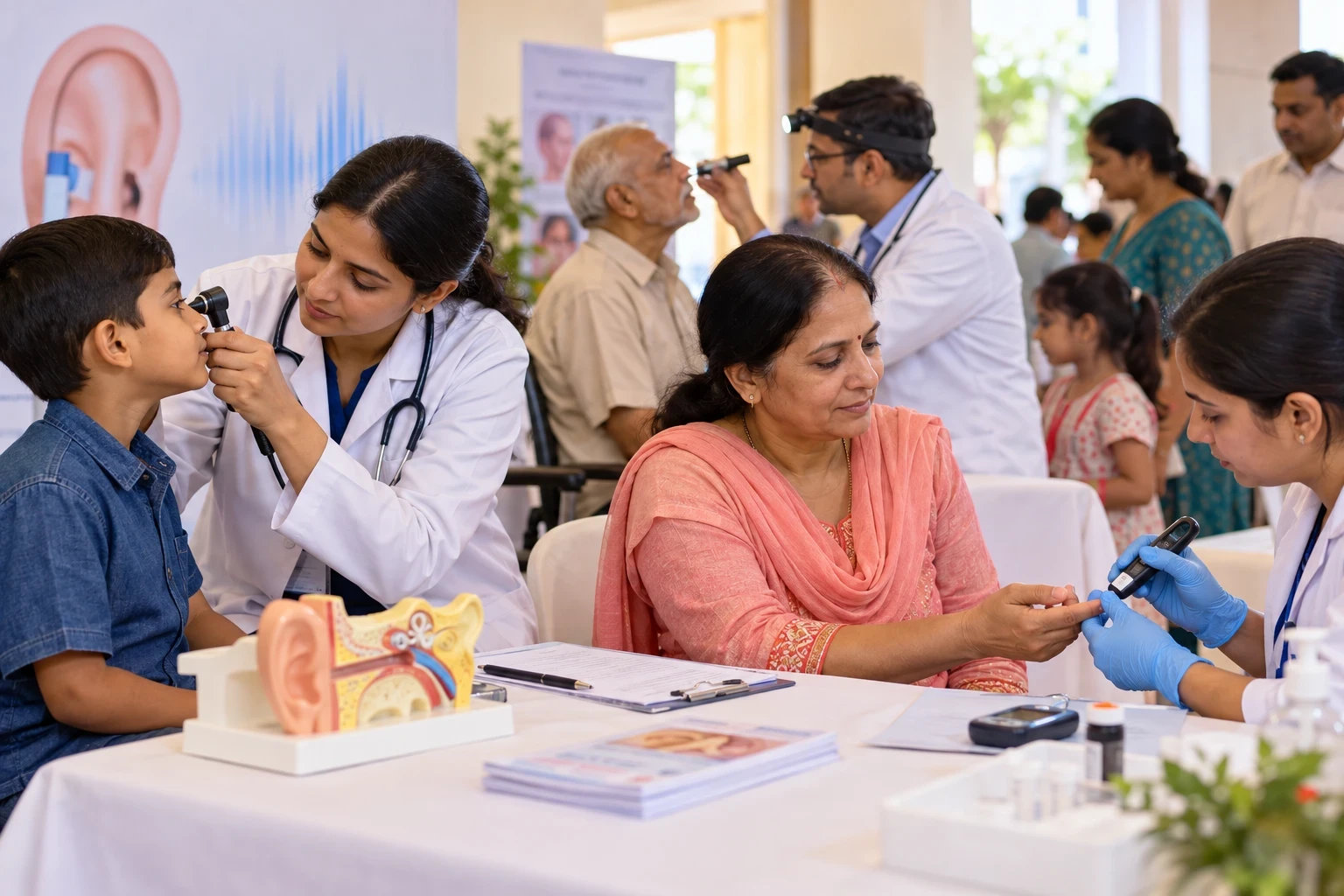
People arrive at a free health camp with the same question: is it worth coming? Will the queues be long and the consultation short? Will the doctor actually listen, or will there be twenty people ahead and a rushed five minutes at the end?
This article answers that question directly for Satkriti Hospital’s free ENT, cochlear implant and diabetes camp on 27 September 2026. It explains what every service station at the camp covers, what happens when a patient sits down, and what to bring to get the most useful outcome in the time available.
The camp runs at Satkriti Hospital, Near Sankat Mochan Mandir, Lanka, Varanasi 221005. It is a walk-in event. No registration. No fee. No referral letter.
What Makes This Camp Different from a Regular OPD Visit
A regular outpatient visit at any specialist hospital means booking an appointment, waiting your turn, seeing a doctor for the condition you came with, and leaving. A health camp is structured differently. Multiple services are available simultaneously, the barrier of a consultation fee is removed, and patients who would not ordinarily seek out a specialist can get an honest assessment of whether they need one.
The 27 September camp at Satkriti Hospital runs four parallel services: ENT consultations, hearing assessments, cochlear implant information sessions, and blood sugar screening. A family with a child who may have hearing loss can, on the same day, get an initial hearing check, speak with a specialist about what it means, and understand whether a cochlear implant needs to be investigated, all at the same address.
That combination, in one place, on one day, without a fee, is not standard in Varanasi outside of Satkriti Hospital’s own programmes.
The ENT Consultation Station — What Happens When You Sit Down
The ENT consultation is the anchor service of the camp. Patients can consult about any ear, nose or throat condition.
What the doctor will assess depends on what the patient presents with. The most common presentations at camps of this kind in Varanasi include the following.
Ear conditions: Chronic ear discharge, reduced hearing, ear pain, a sensation of fullness or ringing in the ear (tinnitus), and itching inside the ear canal. For patients with a history of ear infections, the doctor will want to understand how long the problem has been present, whether it has been treated before, and whether the hearing seems to have changed.
Nose and sinus conditions: Longstanding nasal blockage, recurring sinus headaches, thick nasal discharge, a reduced sense of smell, sneezing in the morning, and facial pain around the cheeks or forehead. These are some of the most common complaints among Varanasi residents during seasonal changes, and many go unaddressed because patients assume nothing can be done beyond decongestants.
Throat conditions: Recurring tonsil infections, hoarseness of voice, difficulty swallowing, a persistent sensation of a lump in the throat, and chronic cough.
The camp consultation is not a diagnostic investigation. An endoscopy, pure tone audiogram, or CT scan cannot be done on the day without equipment scheduled in advance. What the camp consultation provides is specialist assessment, a clear indication of whether further investigation is needed, and a direct referral pathway for any patient who requires follow-up.
Satkriti Hospital’s complete ENT services cover the full range of these conditions, from ear surgeries such as tympanoplasty and mastoidectomy to nasal procedures like endoscopic sinus surgery and rhinoplasty, and throat procedures including tonsillectomy and voice surgery.
The Hearing Assessment Station — Step by Step
Hearing assessment is one of the most used services at this camp, because it is one of the least accessed services in Varanasi outside of a specialist referral.
At the camp, a basic hearing screening will be available. For most adult patients, this involves a simple audiometric screening test to identify whether there is measurable hearing loss and, if so, in which frequency range it falls. For children, behavioural observation, age-appropriate response testing, and parental history together give the clinician a working picture of how the child is responding to sound.
What the camp screening is not: it is not a full diagnostic audiological evaluation. A complete hearing loss evaluation at Satkriti Hospital includes pure tone audiometry across multiple frequencies, impedance testing for middle ear function, and BERA (Brainstem Evoked Response Audiometry) for children who cannot cooperate with standard tests. These require appointment-based slots in the hospital’s audiology department. The camp screening identifies which patients need that full evaluation next.
For parents who are unsure whether their child has a hearing problem, this screening is the right first step. If the child passes, the family leaves with reassurance. If the child shows any sign of hearing difficulty, the camp team will guide the family on what to do next.
The Cochlear Implant Information Session
What is a cochlear implant information session at a health camp? It is a structured one-to-one session where a family can ask every question they have about cochlear implants and get honest, medically accurate answers, without being asked to commit to anything.
The common questions families bring to these sessions in Varanasi:
– Is my child’s hearing loss severe enough for a cochlear implant?
– What does the surgery actually involve and is it safe?
– What happens after surgery? Does the child hear immediately?
– How long does rehabilitation take and what does it cost?
– We do not have money for this. Is there any government support?
– My child is three years old. Is it too late?
The camp team will address all of these. For families who are not aware of the ADIP scheme, the session is often the first time they hear that cochlear implant surgery for children between 0 and 5 years from economically weaker sections can be fully funded by the Ministry of Social Justice and Empowerment. Satkriti Hospital works directly with this scheme, handles the paperwork in-house, and can tell a family within the session whether they are likely to qualify.
The hospital is also empanelled under Ayushman Bharat PMJAY for ENT services, which provides eligible families up to Rs. 5 lakh per year for covered treatments.
A detailed guide to the cochlear implant surgery and rehabilitation pathway at Satkriti Hospital is available in the complete cochlear implant article published by the hospital. Families who want to read up before the camp are encouraged to start there.
The Diabetes Screening Station — What You Will Get
The diabetes screening station runs independently from the ENT services and can be visited by anyone regardless of whether they have an ear or throat complaint.
What happens at the screening: a blood glucose reading is taken, either fasting or random depending on when the patient last ate. The result is explained to the patient on the spot. If the reading falls in a normal range, the patient is advised when to retest as routine. If the reading suggests pre-diabetes or elevated blood sugar, the camp team explains what that means clinically, what symptoms to watch for, and how to arrange a proper consultation for a full diabetes management plan.
What is not part of the camp screening: HbA1c testing, kidney function panels, retinal examination, or foot assessment. These are components of a complete diabetes care evaluation at Satkriti Hospital and require a scheduled appointment. The camp screening is a starting point, not a full diagnostic workup.
The practical value of this screening is significant for patients who have never had a blood sugar check. Many patients in Varanasi discover they have elevated sugar only when it has already caused secondary complications. A single camp-day reading that flags an anomaly and sends the patient for proper follow-up can change the trajectory of their health.
What to Bring and What to Expect on the Day
What to bring:
For ENT consultations: any previous prescription or discharge summary from an ENT visit, a current audiogram if available, and a list of medications the patient is currently taking.
For hearing assessment with a child: the child’s immunisation record, any previous hearing test reports such as a newborn hearing screening result, and if the child is already using a hearing aid, the current device settings if known.
For the cochlear implant session: BERA report if available, current hearing aid trial record, Aadhaar card, ration card, income certificate, and Ayushman card if the family is a PMJAY beneficiary. These documents are not required to attend, but having them speeds up the ADIP eligibility check considerably.
For diabetes screening: no documents are needed. Come with information about whether you have eaten in the last 8 hours, and bring any previous blood sugar reports if you have them.
What to expect on the day:
The camp will be organised with separate stations for each service. Patients and families can visit more than one station on the same day. The consultations are free at all stations. No payment will be requested at any point during the camp.
Camp address: Satkriti Hospital, Near Sankat Mochan Mandir, Lanka, Varanasi 221005.
Contact: +91 87658 48001.
Date: 27 September 2026 (Sunday).
Frequently Asked Questions
Can I visit more than one service station at the same camp?
Yes. A family can attend the hearing assessment, cochlear implant information session, and diabetes screening on the same day. There is no restriction on which services a visitor accesses.
Will the ENT doctors at the camp be the hospital’s regular consultants?
Yes. The camp is staffed by Satkriti Hospital’s own ENT team, led by Dr. Manoj Kumar Gupta, Dr. Abhineet Jain, and Dr. Ankit Ojha. This is not a visiting camp with temporary staff.
What if the doctor says my child needs a cochlear implant? What happens next?
The camp doctor will advise you on the recommended next step, which is typically a full audiological evaluation and ENT assessment at the hospital. That evaluation can be booked directly after the camp. No surgical decision is made at a camp consultation.
Is the blood sugar screening truly free, even if the result is abnormal?
Yes. The screening is free regardless of the result. If a follow-up consultation is needed for elevated blood sugar, that appointment would be booked separately through the hospital’s diabetes care department.
My parent is elderly and has hearing loss. Should they come?
Yes. Adult hearing loss is assessed at the camp alongside paediatric cases. Elderly patients with age-related hearing loss, in particular, benefit from specialist assessment to determine whether a hearing aid is appropriate or whether there is an underlying treatable condition.
What are the hospital’s cashless treatment options for follow-up care?
Satkriti Hospital is empanelled under Ayushman Bharat PMJAY and accepts listed insurance plans for cashless treatment. The Ayushman desk at the hospital can verify eligibility on presentation of the PMJAY card.
Come Prepared. Leave with Clarity.
The camp on 27 September 2026 is not a marketing event. It is a clinical service, open to everyone, with no conditions attached. For families who have been waiting for a low-barrier reason to get a hearing check, a specialist opinion on a chronic ENT problem, or a first blood sugar reading, this is that reason.
book a follow-up appointment if you need one after the camp, or visit the contact page for directions and department numbers.
