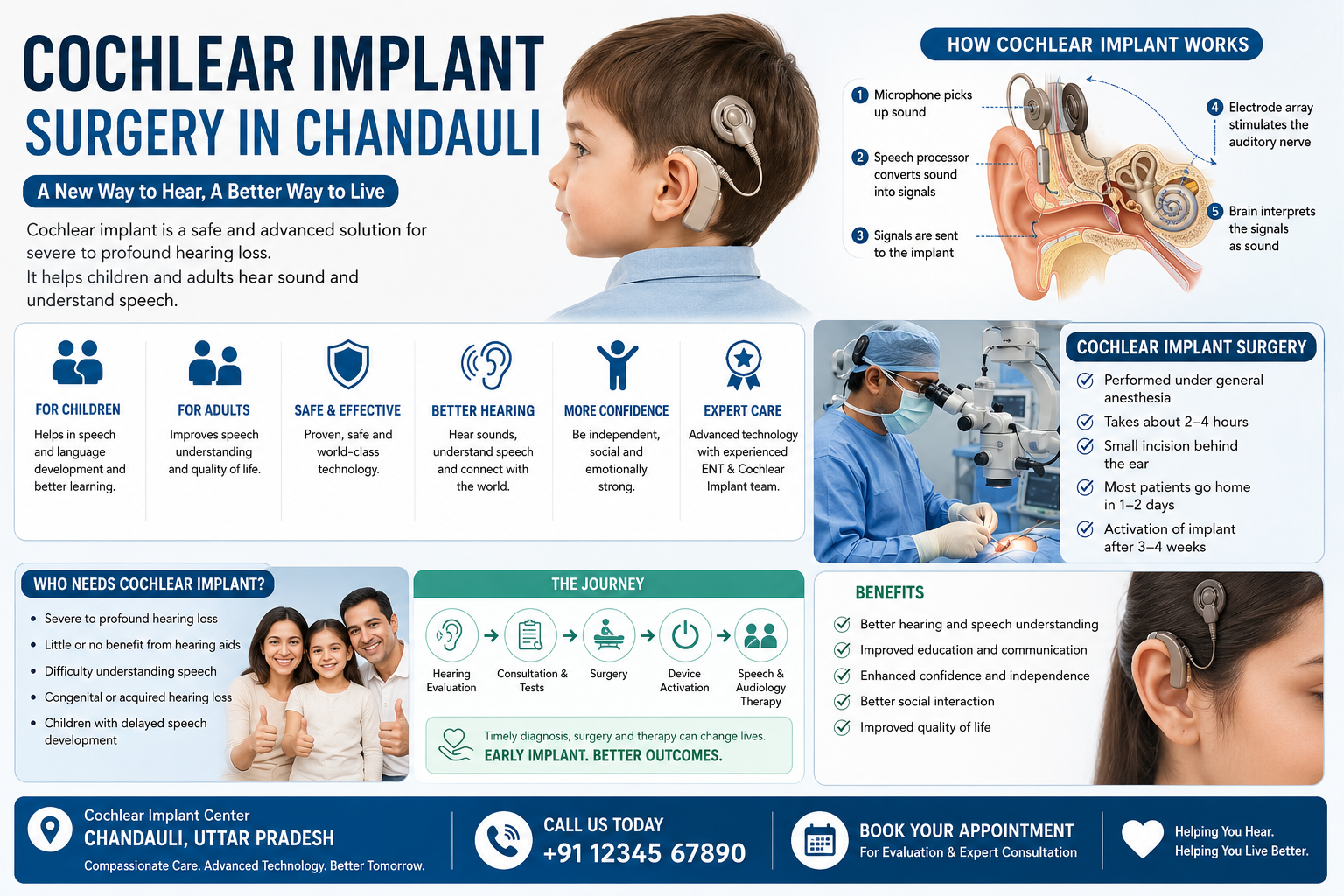
Hearing is one of the most important senses that helps us communicate, learn, and connect with the world around us. Unfortunately, many children and adults suffer from severe to profound hearing loss, making it difficult or impossible to understand speech even with powerful hearing aids. In such cases, Cochlear Implant Surgery offers a life-changing solution.
For residents of Chandauli and nearby regions, access to advanced hearing care has become easier than ever. Cochlear implants have transformed the lives of thousands of people by enabling them to hear sounds, understand speech, and lead a more independent life.
This guide covers everything you need to know about cochlear implant surgery in Chandauli, including who needs it, how it works, benefits, costs, surgery procedure, recovery, and frequently asked questions.
What is a Cochlear Implant?
A cochlear implant is a sophisticated electronic medical device designed for individuals with severe to profound sensorineural hearing loss who receive little or no benefit from hearing aids.
Unlike hearing aids, which simply amplify sounds, a cochlear implant bypasses the damaged parts of the inner ear (cochlea) and directly stimulates the auditory nerve. The auditory nerve then sends signals to the brain, which interprets them as sound.
Components of a Cochlear Implant
A cochlear implant consists of two main parts:
External Components
- Microphone
- Speech Processor
- Transmitter Coil
Internal Components
- Receiver-Stimulator
- Electrode Array inserted into the cochlea
Together, these components help convert sound into electrical signals that the brain can recognize.
Who Needs Cochlear Implant Surgery?
Cochlear implants are recommended for individuals who have:
- Severe to profound hearing loss
- Poor speech understanding despite hearing aids
- Difficulty communicating in daily life
- Congenital (birth-related) hearing loss
- Progressive hearing loss
- Hearing loss due to infections, trauma, or genetic causes
Children Who May Benefit
Children who:
- Do not respond to sounds
- Have delayed speech development
- Fail newborn hearing screening
- Have congenital deafness
Early implantation significantly improves speech and language development.
Adults Who May Benefit
Adults who:
- Have lost hearing later in life
- Cannot understand speech despite hearing aids
- Experience difficulty in social and professional settings
Causes of Severe Hearing Loss
Several factors can lead to hearing loss severe enough to require a cochlear implant.
In Children
- Genetic conditions
- Birth complications
- Premature birth
- Infections during pregnancy
- Lack of oxygen during birth
- Neonatal jaundice
In Adults
- Age-related hearing loss
- Chronic ear infections
- Head injury
- Noise exposure
- Viral infections
- Certain medications
Signs That You May Need a Cochlear Implant
Common signs include:
- Inability to understand speech
- Frequently asking others to repeat themselves
- Increasing TV volume excessively
- Difficulty hearing on the phone
- Poor response even with hearing aids
- Social withdrawal due to hearing difficulties
If these symptoms are present, a detailed hearing evaluation is recommended.
How Does a Cochlear Implant Work?
The process involves several steps:
Step 1: Sound Collection
The microphone picks up sounds from the environment.
Step 2: Sound Processing
The speech processor converts sounds into digital signals.
Step 3: Signal Transmission
The transmitter sends signals to the internal implant.
Step 4: Electrical Stimulation
Electrodes stimulate the auditory nerve.
Step 5: Brain Interpretation
The brain interprets these signals as meaningful sounds.
Over time, the brain learns to recognize speech and environmental sounds more effectively.
Evaluation Before Cochlear Implant Surgery
Before surgery, patients undergo a comprehensive assessment.
Hearing Tests
- Pure Tone Audiometry
- Speech Audiometry
- Otoacoustic Emissions (OAE)
- Brainstem Evoked Response Audiometry (BERA)
Imaging Studies
- CT Scan
- MRI Scan
These help assess the structure of the inner ear and auditory nerve.
Speech and Language Assessment
Especially important for children.
Medical Evaluation
ENT specialists evaluate overall health and suitability for surgery.
Cochlear Implant Surgery Procedure
Cochlear implant surgery is generally performed under general anesthesia.
Surgical Steps
- Patient is given anesthesia.
- A small incision is made behind the ear.
- The surgeon accesses the mastoid bone.
- The receiver is placed under the skin.
- Electrodes are inserted into the cochlea.
- The incision is closed carefully.
Duration of Surgery
Typically 2–4 hours.
Most patients can return home within 1–2 days after surgery.
Is Cochlear Implant Surgery Safe?
Yes.
Cochlear implant surgery is considered safe and has a high success rate when performed by experienced ENT and cochlear implant surgeons.
Possible Risks
Although uncommon, risks may include:
- Infection
- Dizziness
- Tinnitus
- Facial nerve injury
- Device malfunction
Proper surgical expertise minimizes these risks significantly.
Recovery After Surgery
Recovery is usually smooth.
Immediately After Surgery
Patients may experience:
- Mild discomfort
- Temporary dizziness
- Swelling around the incision
Healing Period
The surgical site typically heals within 2–4 weeks.
Activation of Implant
The external processor is usually fitted 3–4 weeks after surgery.
This is known as the “switch-on” day.
What Happens After Activation?
The first activation is an exciting milestone.
Patients begin hearing sounds through the implant, though the sounds may initially seem unusual.
Over time, the brain adapts and learns to interpret sounds naturally.
Follow-Up Sessions
Several programming sessions are required to optimize hearing performance.
These adjustments are called “mapping.”
Importance of Auditory Verbal Therapy (AVT)
Surgery alone does not guarantee success.
Auditory Verbal Therapy helps patients learn how to interpret sounds and develop communication skills.
Benefits of AVT
- Better speech development
- Improved listening skills
- Enhanced communication abilities
- Greater academic success in children
Regular therapy plays a crucial role in long-term outcomes.
Benefits of Cochlear Implant Surgery
Improved Hearing
Patients can hear environmental sounds and speech more clearly.
Better Communication
Improved ability to engage in conversations.
Enhanced Education
Children gain access to mainstream education opportunities.
Increased Confidence
Patients become more socially active and independent.
Improved Quality of Life
The ability to hear significantly impacts emotional and psychological well-being.
Cochlear Implant for Children
Early intervention is critical.
Research consistently shows that children implanted at a younger age achieve better speech and language outcomes.
Advantages for Children
- Speech development
- Language acquisition
- Social interaction
- Educational growth
Parents should seek evaluation as soon as hearing loss is suspected.
Cochlear Implant for Adults
Adults who lose hearing later in life often experience remarkable benefits.
Improvements Include
- Better speech understanding
- Easier communication
- Enhanced workplace performance
- Reduced social isolation
Many adults report dramatic improvements in quality of life after implantation.
Cost of Cochlear Implant Surgery in Chandauli
The cost of cochlear implantation varies depending on:
- Implant brand
- Hospital facilities
- Surgeon expertise
- Rehabilitation requirements
Typically, the total expense may range from several lakhs of rupees.
However, many patients may be eligible for financial assistance through government schemes, insurance coverage, charitable foundations, and CSR-supported healthcare programs.
Government Support for Cochlear Implants
Several government initiatives aim to help children with hearing impairment.
These programs may provide:
- Financial support
- Free screening
- Rehabilitation services
- Hearing healthcare assistance
Patients should consult cochlear implant centers for current eligibility criteria.
Choosing the Right Cochlear Implant Center
When selecting a center, consider:
- Experienced cochlear implant surgeons
- Advanced diagnostic facilities
- Comprehensive rehabilitation services
- Speech therapy support
- Long-term follow-up care
A multidisciplinary team ensures the best outcomes.
Frequently Asked Questions
Can a person hear normally after cochlear implantation?
While hearing may not be exactly the same as natural hearing, many recipients achieve excellent speech understanding and communication.
Is surgery painful?
The procedure is performed under anesthesia, and postoperative discomfort is usually mild.
How long does the implant last?
The internal implant is designed to last for many years, often decades.
Can both ears be implanted?
Yes, bilateral cochlear implantation is possible in suitable candidates.
Is there an age limit?
There is no strict upper age limit. Suitability depends on hearing status and overall health.
Conclusion
Severe hearing loss can affect every aspect of life, from communication and education to social relationships and emotional well-being. Fortunately, cochlear implant surgery offers hope and a proven solution for individuals who receive limited benefit from hearing aids.
For families in Chandauli, timely diagnosis, expert evaluation, successful surgery, and consistent rehabilitation can transform lives. Whether it is a child born with hearing loss or an adult who has gradually lost hearing, cochlear implants can open the door to a world of sound, speech, and opportunity.
If you or a loved one is struggling with severe hearing loss, consult a qualified cochlear implant specialist to determine whether cochlear implantation is the right option.
