
Ear Drum Repair Surgery (Tympanoplasty) in Varanasi: Procedure, Cost, Recovery and Everything You Need to Know
October 29, 2026
A hole in the eardrum rarely announces itself with sharp pain. It shows up as water or pus trickling out of the ear every few weeks, a dull sense that one side hears less than the other, and the growing habit of turning your good ear towards whoever is speaking. Many patients who come to us for ear drum repair surgery in Varanasi have been living with this for five, ten, sometimes twenty years, treating each episode with drops from the chemist and waiting for the next one.
That cycle has an end point, and it is usually tympanoplasty. This guide explains what the surgery involves, how we assess whether you need it, what decides the cost, and what recovery looks like week by week. It reflects how ear surgery is practised at Satkriti Hospital, Lanka, Varanasi, where tympanoplasty and ossiculoplasty have been part of our ear surgery list since the hospital was founded in 2012.
What is tympanoplasty?
What is tympanoplasty? Tympanoplasty is surgery to close a hole or tear in the eardrum, the thin membrane that separates the ear canal from the middle ear. The surgeon seals the perforation with a graft of the patient's own tissue, so the middle ear becomes a closed, protected space again.
It has two goals: to stop infection getting in, which ends the cycle of repeated discharge, and to improve hearing, because a perforated eardrum cannot transmit sound properly to the tiny bones behind it.
When those bones (the ossicles) have also been eroded by long-standing infection, the surgeon reconstructs them in the same sitting. That added step is called ossiculoplasty.
Signs that point to a perforated eardrum
Any of the following deserve an ENT examination rather than another round of over-the-counter drops:
- Ear discharge that keeps coming back, often with a foul smell
- Reduced hearing on one side, noticed most in a crowd or on the phone
- A whistling or ringing sound in the ear
- Water entering the ear during a bath immediately causing pain or discharge
- A feeling of fullness or pressure that never fully clears
- Occasional dizziness along with any of the above
One pattern is worth naming because it is so common here. A child has repeated colds and ear pain, each episode of discharge is treated, and nobody checks the eardrum afterwards. Twenty years later the same person arrives as an adult with a dry perforation and avoidable hearing loss. If discharge has happened more than two or three times, ask for the eardrum to be examined.
When surgery is advised, and when it can wait
Not every perforation needs an operation straight away. Small, dry, recent perforations sometimes heal on their own within a few weeks, and we do watch those.
Surgery is advised when:
- The perforation has stayed open for more than three months
- Discharge keeps returning despite correct medical treatment
- Hearing loss is measurable on an audiogram and is affecting work, study or school
- The patient wants to swim, travel by air, or simply stop guarding the ear from water
- There is a cholesteatoma or suspicion of one, which makes surgery necessary rather than optional
The ear also has to be in the right condition. We prefer it dry, with no active discharge, for about four to six weeks before operating. Grafts take up far better in a dry ear, so settling the infection first is not wasted time.
Tests before eardrum repair surgery
The assessment at our ear care department is thorough, because the findings decide which type of tympanoplasty is appropriate.
Otoendoscopic examination. A magnified view of the eardrum shows the exact size and position of the perforation and the state of the middle ear lining.
Pure tone audiometry and tympanometry. These measure how much hearing has been lost and whether the loss is conductive, which indicates whether the ossicles are involved. Both are done in our audiology and endoscopy unit. We were among the first centres in the region to offer OAE testing for inner ear evaluation, which matters in young children.
HRCT of the temporal bone, when cholesteatoma or ossicular disease is suspected on examination.
Pre-anaesthetic check up, with routine blood work, followed by six hours of fasting before surgery.
How the procedure is performed
Tympanoplasty is done under anaesthesia and usually takes between one and two hours, depending on the extent of the work.
The surgeon freshens the edges of the perforation, then harvests a graft from the patient's own body. The usual choices are temporalis fascia from just above the ear, tragal perichondrium, or cartilage. Using the patient's own tissue is the reason rejection is not a concern.
The graft is placed either under the remaining eardrum (underlay technique) or over it (overlay), and supported until it takes up its own blood supply. If the ossicular chain is broken or eroded, it is reconstructed at this point.
Two routes are available. Endoscopic tympanoplasty works entirely through the ear canal with no cut behind the ear, which suits most straightforward perforations. Microscopic ear surgery gives wider access and is preferred for larger perforations, revision cases and mastoid disease. Both approaches are performed here, and the choice is made on your findings, not on preference.
A pack is placed in the ear canal at the end and removed at the follow up visit, usually at two to three weeks.
Tympanoplasty cost in Varanasi: what actually decides the figure
This is the question patients ask first, and an honest answer has to start with a caveat. Published estimates for eardrum repair surgery across Indian cities run from about ₹30,000 to ₹85,000, and insurers and hospital cost pages quote ranges of roughly ₹30,000 to ₹1 lakh depending on the city and the complexity. Varanasi generally sits below metro pricing.
No hospital can quote your number before examining your ear, because the same procedure name covers very different amounts of work. These are the factors that move the figure:
| What affects the cost | Why it changes the figure |
|---|---|
| Type of tympanoplasty | Eardrum closure alone costs less than a repair that also rebuilds the middle ear bones |
| Endoscopic or microscopic approach | Equipment and theatre time differ |
| Graft used | Fascia, perichondrium and cartilage differ in effort and time |
| Investigations before surgery | Audiometry for everyone, HRCT only when indicated |
| Anaesthesia and theatre time | Larger or revision cases take longer |
| Room category and length of stay | General ward or private room, one night or two |
| Medicines and follow up | Drops, pack removal, repeat audiometry |
| Scheme or insurance cover | Ayushman Bharat or a cashless policy lowers what you pay |
Ask for a written estimate before admission, and ask what it includes. We give one after the examination.
Ayushman Bharat and cashless treatment
Satkriti Hospital is NABH accredited and empanelled under Ayushman Bharat PM-JAY. Ear surgery, including tympanoplasty and mastoid procedures for chronic ear discharge and perforated eardrum, is among the ENT surgery we perform under the scheme at our Varanasi facility.
Two points decide whether a claim goes smoothly. Bring the Ayushman card with Aadhaar so eligibility can be verified at the desk, and let pre-authorisation be approved before treatment begins. The most common cause of a delayed claim is starting treatment first and raising the paperwork afterwards. Eligibility details are on our Ayushman Bharat page, and private insurer empanelment under cashless treatment.
Recovery after tympanoplasty, week by week
First week. Expect ear ache rather than severe pain, and a blocked feeling from the pack. Mild blood staining on the cotton is normal. Take the antibiotics and drops as prescribed and do not stop them early.
Weeks one to three. The ear canal stays dry. Place a cotton ball smeared with petroleum jelly in the ear while bathing, and wash hair carefully. Do not blow your nose for at least three weeks, because that pressure travels straight up to the healing graft. If you must sneeze, sneeze with your mouth open. No heavy lifting and no straining.
Weeks two to three. The pack is removed at your follow up visit and the graft is inspected.
Weeks four to six. No swimming or diving, and avoid air travel until cleared. Desk work is usually fine well before this.
Weeks eight to twelve. Repeat audiometry to measure the hearing gain. Hearing improves gradually as the middle ear settles, so the figure at three months means more than how you feel in the second week.
Full healing takes two to three months in most people, and every ear recovers at its own pace.
What is the success rate of tympanoplasty?
How successful is eardrum repair surgery? Published studies report closure of the perforation in roughly 75 to 90 percent of cases, and a widely cited figure is around 90 percent for suitable ears.
The range exists for a reason. Results are better when the perforation is small, the ear has been dry before surgery, the middle ear lining is healthy, and it is a first operation rather than a revision. Results are less predictable with large perforations, active infection, eustachian tube problems, or previous failed surgery.
Two things are in your control: getting the ear dry before surgery, and following the dry ear and no nose blowing instructions afterwards. Most graft failures we see follow water entry or nose blowing in the first three weeks.
Frequently Asked Questions
Will my hearing come back fully after tympanoplasty?
Closing the eardrum usually recovers the hearing lost because of the perforation. If the middle ear bones were also damaged, the gain depends on how well they can be reconstructed. Inner ear hearing loss, if present alongside, is not corrected by this surgery, which is why pre-operative audiometry matters.
Is tympanoplasty painful?
The surgery is done under anaesthesia, so there is no pain during it. Afterwards most patients describe a blocked, uncomfortable ear with mild ache for about a week rather than sharp pain.
How long will I be in hospital?
Usually same day or next morning discharge, depending on the extent of surgery and your general health.
Can a perforated eardrum heal without surgery?
Small, recent perforations sometimes close on their own. A perforation that has stayed open for months, or one with repeated discharge, usually will not, and continuing to wait only adds more years of infection and hearing loss.
Can both ears be operated at the same time?
No. The ears are operated one at a time, so you always have one hearing ear during recovery and each graft can be monitored properly.
Is tympanoplasty safe for children?
Yes, when the timing is right. In children we assess the pattern of colds and ear infections first, because frequent upper respiratory infections affect graft uptake. Treating the nose and adenoids first often gives the ear a better chance.
Does Satkriti Hospital do the surgery under Ayushman Bharat?
Yes. The hospital is empanelled under PM-JAY and ear surgery is performed under the scheme. Coverage depends on your eligibility and the approved package, so confirm at the Ayushman desk before admission.
Get your eardrum examined before another year passes
If your ear has been discharging on and off for years, or if people have started telling you that you speak loudly, the useful next step is small: an ENT examination with a hearing test. It takes one visit and it tells you whether you need surgery, whether you can wait, and what it would cost in your case.
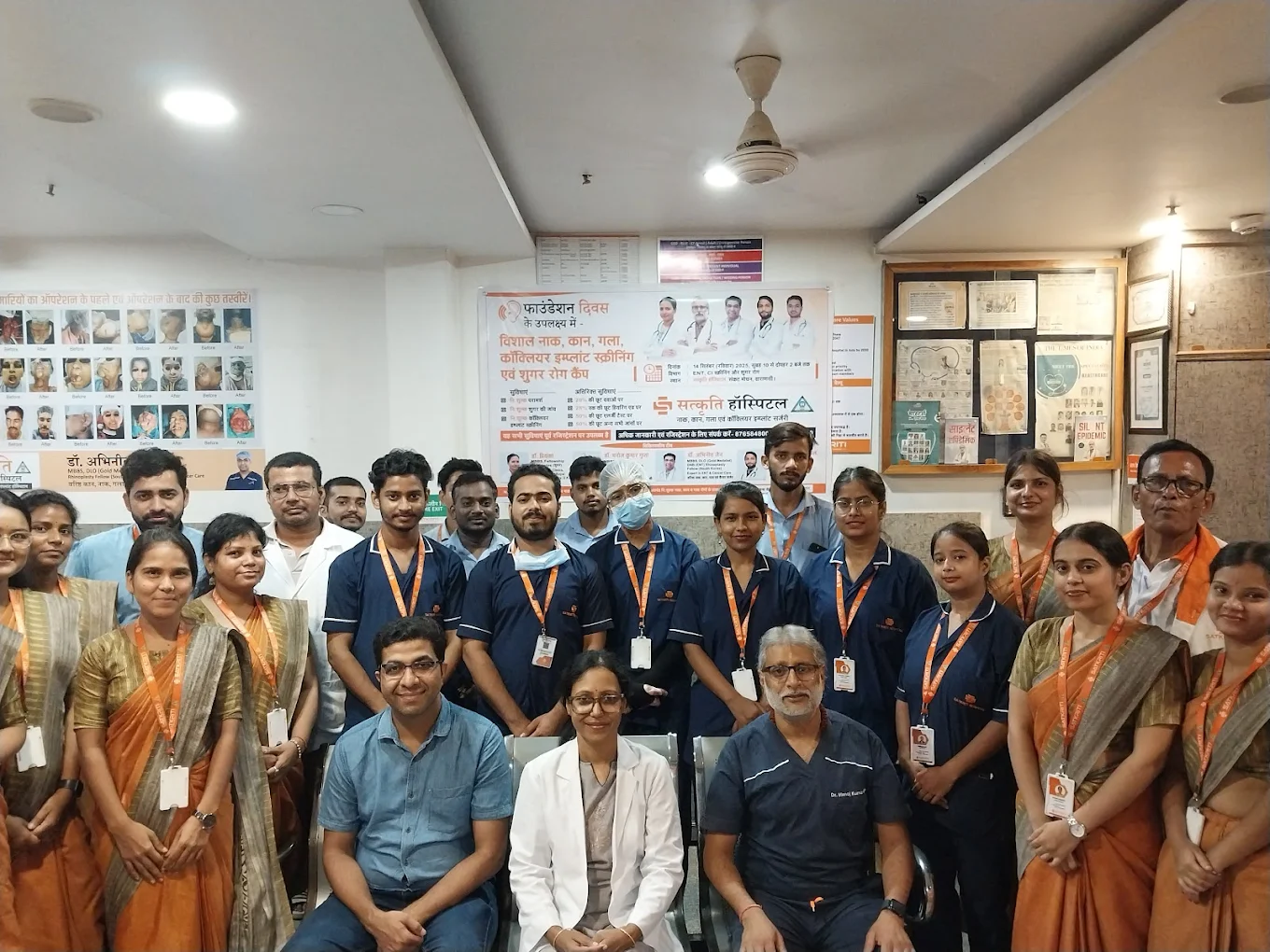
Dr. Manoj Kumar Gupta and our ENT team see ear patients at Satkriti Hospital, Sankat Mochan Road, Lanka, Varanasi 221005. The OPD runs Monday to Saturday, 10:00 AM to 7:00 PM. Call 087658 48001, book through our appointment page, or start with an online consultation if you are travelling in from Jaunpur, Ghazipur, Chandauli or Mirzapur. Bring old audiograms, prescriptions and scans with you.
This article is for general information and does not replace an in person consultation. Treatment plans, costs and recovery times are decided after clinical examination.
- Previous: Satkriti Hospital Varanasi: Complete Guide to Services, Departments, NABH Accreditation, and Patient Reviews 2026
- Next: गले में खराश और टॉन्सिल: बच्चों में टॉन्सिल सर्जरी कब जरूरी है? (Satkriti Hospital, Varanasi)
- गले में खराश और टॉन्सिल: बच्चों में टॉन्सिल सर्जरी कब जरूरी है? (Satkriti Hospital, Varanasi)
- Satkriti Hospital Varanasi: Complete Guide to Services, Departments, NABH Accreditation, and Patient Reviews 2026
- Allergy Testing and Treatment in Varanasi: Skin Prick Test, Immunotherapy, and Long-Term Relief at Satkriti Hospital
By satkriti-admin
Comment
Your email address will not be published. Required fields are marked *